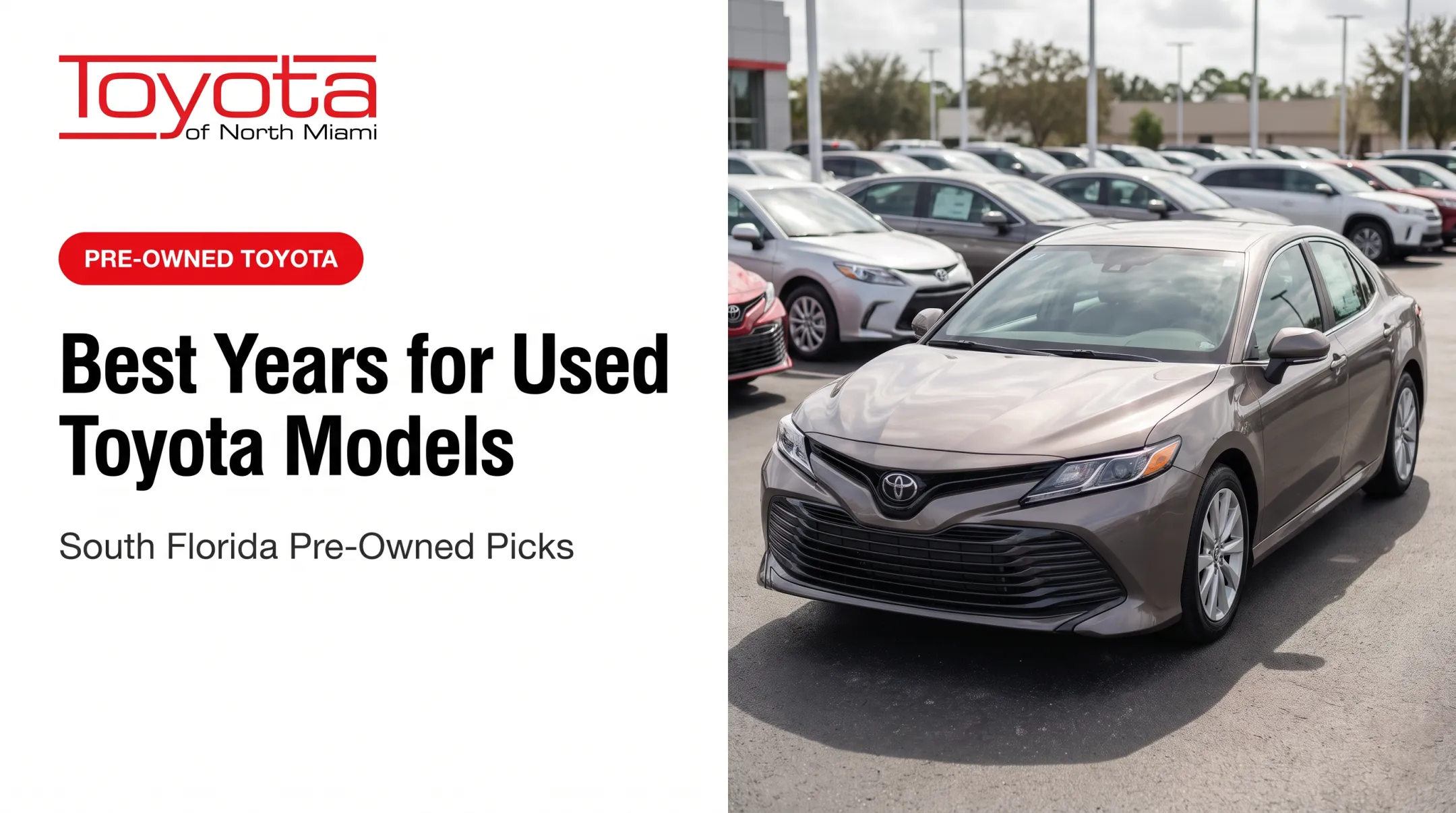
Camry reliability isn't a single number stamped on a model year. It depends on the generation, the engine under the hood, how well the previous owner maintained it, mileage, whether open recalls were ever fixed, and the car's overall condition.
This guide breaks down the strongest year ranges, budget-friendly alternatives, years that deserve extra scrutiny, and the checks every buyer should run before signing paperwork.
Key Takeaways
- 2020–2023 models bring newer safety tech and hybrid power; 2015–2017 delivers proven mechanicals for less.
- 2013–2014 Camrys can be dependable and affordable, but test for transmission shudder and confirm service records first.
- 2007–2011 examples need extra caution for oil consumption, recalls, and age-related wear.
- Evaluate four-cylinder, V6, and hybrid Camrys separately: each solves different needs.
- Pull a vehicle-history report, check open recalls, and get an independent inspection before you buy.
Overview of Used Toyota Camry Generations and Reliability
Grouping Camrys by generation makes shopping easier. Cars built on the same platform typically share engines, transmissions, safety equipment, and known issues, so understanding generation boundaries narrows your search fast.
Here's the lineup sold in the US:
| Generation | US Model Years | Hybrid Available |
|---|---|---|
| Fourth | 1997–2001 | No |
| Fifth | 2002–2006 | No |
| Sixth | 2007–2011 | Yes (launched 2007) |
| Seventh | 2012–2017 | Yes |
| Eighth | 2018–2024 | Yes |
| Ninth | 2025 onward | Hybrid-only |
The Camry Hybrid didn't exist before the sixth generation, so don't expect to find one from 2002–2006. Hybrid availability also varies by trim within a given year, not just by generation, so confirm the specific configuration before you fall in love with a listing.
With that framework in place, here's how each buyable range stacks up on reliability evidence, mechanical maturity, and real-world ownership risk.

Best and Most Reliable Used Toyota Camry Years
These rankings weigh documented reliability data, powertrain durability, safety tech, repair risk, resale value, and how easy it is to find a well-maintained example on dealer lots today.
2020–2023 Toyota Camry: Best Newer Overall Choice
If you want a modern Camry without new-car pricing, this eighth-generation stretch is hard to beat. You get updated driver-assistance features, a mature platform, and a hybrid option across most trims.
Consumer Reports' 2023 data rates each model year from 2020 through 2023 as more reliable than other cars from the same model year, based on owner surveys. That's encouraging, though it's a same-year comparison rather than a ranking between those four years against each other.
Driver-assistance tech improved noticeably within this range:
- 2020 comes with Toyota Safety Sense-P standard across the lineup, plus hybrid trims in LE, SE, and XLE.
- 2021 upgrades to Toyota Safety Sense 2.5+, adding daytime bicyclist detection and low-light pedestrian detection.
- 2022 Camry LE includes Toyota Safety Sense 2.5+ and offers a 2.5L four-cylinder rated at 203 hp with 28 city/39 highway mpg.
Engine-wise, the 2022 lineup breaks down into a 2.5L four-cylinder (203 hp), a 3.5L V6 (301 hp, 267 lb-ft), and a hybrid rated at 208 net hp with a combined 52 mpg. The four-cylinder suits daily commuters, the V6 fits buyers who want quicker acceleration, and the hybrid targets fuel economy above all else.

Before buying, check:
- Recall status, since certain 2018–2020 Camrys were part of a fuel-pump recall and certain 2020–2022 models had a passenger-airbag sensor campaign
- Whether any remaining factory warranty or Toyota Certified status transfers with the car
- Transmission smoothness during a real test drive, not just a parking-lot loop
A 2023 Camry SE in Toyota of North Miami's pre-owned inventory recently listed at $22,472 with 91,627 miles, while a lower-mileage 2024 SE with 35,518 miles and a CARFAX 1-Owner badge listed at $26,262. That spread shows how much mileage and documentation affect price within the same generation.
2015–2017 Toyota Camry: Best Balance of Reliability and Value
This late seventh-generation range hits a sweet spot: proven mechanicals, a noticeably lower price than most eighth-generation cars, and a meaningful styling refresh.
Toyota's 2015 announcement describes nearly 2,000 parts changed for the model year, including a new front bumper, grille, and available LED headlamps. Only the roof carried over unchanged.
The verified 2015 gasoline engines:
| Engine | Horsepower | Torque | Transmission |
|---|---|---|---|
| 2.5L four-cylinder | 178 hp | 170 lb-ft | Six-speed automatic |
| 3.5L V6 | 268 hp | 248 lb-ft | Six-speed automatic |
Available (not standard) safety features during this refresh included Pre-Collision System, Adaptive Cruise Control, Lane Departure Alert, and Blind Spot Monitor. Infotainment options ranged from a basic 6.1-inch display up to a 7-inch Entune system.
Inspection priorities for this range:
- Transmission smoothness through multiple gear changes
- Oil leaks around the valve cover and timing components
- Suspension wear, especially on higher-mileage examples
- Air conditioning performance in Florida heat
- Consistent oil-change documentation
One known issue: a 2015 recall addressed a potentially damaged electric power-steering ECU resistor that could increase low-speed steering effort. It doesn't affect every car from this range, but it's worth a quick VIN check.
2013–2014 Toyota Camry: Strong Lower-Cost Option With Specific Checks
These more affordable seventh-generation Camrys carry the platform's core strengths, but condition and mileage matter more as the cars age.
Toyota issued a technical service bulletin covering certain 2012–2014 Camrys with the U760 transmission, describing a brief shudder under light load around 25–50 mph, often just before an upshift. Toyota later extended a warranty enhancement for this exact issue, historically covering 8 years or 150,000 miles.
Test for this before buying:
- Drive at a steady 30–40 mph and feel for shudder during light acceleration
- Ask the seller or a technician whether the torque converter or ECM was ever serviced
- Have a shop scan for stored transmission codes
Hybrid buyers should note that 2013 came in LE and XLE trims, while 2014 offered LE, XLE, and a mid-year SE Limited Edition. Four-cylinder, V6, and hybrid versions all carry different inspection priorities, so match the powertrain to your budget and maintenance tolerance.
Buyer profile: value-focused commuters who don't mind older infotainment in exchange for real savings. A clean title and complete service history matter more here than a few thousand extra miles on the odometer.
2002–2006 Toyota Camry: Budget Choice Only When Condition Is Exceptional
These fifth-generation Camrys offer the lowest entry price on this list, but age introduces real risk: brittle rubber hoses, worn suspension bushings, aging cooling systems, and electronics that may no longer behave reliably.
A handful of owner complaints filed with NHTSA describe coolant leakage linked to head-gasket failure on 2002 and 2003 four-cylinder models. These are owner-reported allegations, not confirmed defect findings across the entire range, but they're worth asking about.
Timing drive matters here:
- Four-cylinder engines use a timing chain
- V6 engines use a timing belt that needs periodic replacement
No hybrid existed in this generation, so skip any hybrid-battery concerns entirely. Before buying, insist on a full inspection covering the underbody, cooling system, steering, brakes, and any signs of flood or accident repair. A well-documented four-cylinder with a clean history usually beats a higher-mileage V6 with no paperwork.
2007–2011 and Early 2018–2019 Camrys: Approach With Additional Scrutiny
"Avoid" is too strong a word here. Condition, engine configuration, and repair history can flip the decision for an individual car.
For 2007–2011 models, Toyota documentation covers oil-consumption concerns on certain 2007–2009 gasoline engines and 2007–2011 hybrid models, addressed through a warranty enhancement involving a piston-ring repair kit. Toyota also switched from a 2.4L to a 2.5L four-cylinder starting in 2010, so not every car in this range shares the same engine. A separate recall covered certain 2007–2010 accelerator pedals that could stick or return slowly.
For early eighth-generation cars (2018–2019), Toyota technical bulletins describe shift shock on startup for 2018 models and slow-roll hesitation after specific downshift patterns on 2019 models. Both were addressed through ECM software updates, not full transmission recalls.
Walk away if you find:
- Unresolved open recalls
- Warning lights the seller can't explain
- Missing or inconsistent maintenance records
- Evidence of structural or flood damage
- An inspection revealing expensive repairs waiting to happen
How We Chose the Best Used Toyota Camry Years
This ranking pulls from manufacturer technical bulletins, NHTSA's recall database, owner-complaint records, and independent reliability surveys. We treated reported complaints and confirmed defects as separate categories throughout.
Buyer criteria that mattered most:
- Documented service history over odometer reading alone
- Powertrain condition relative to mileage
- Clean title and accident/flood history
- Completed recalls, verified by VIN
- Availability of replacement parts and qualified Toyota service
A pre-purchase inspection is non-negotiable, even for a highly rated year. Include:
- A cold start and real road test
- A scan for stored diagnostic codes
- Checks of fluids, visible leaks, brakes, and suspension
- A look at tire age
Picking the right engine:
| Priority | Best Choice | Why |
|---|---|---|
| Simple, affordable commuting | Four-cylinder | Lower maintenance cost, solid fuel economy |
| Stronger acceleration | V6 | More power, higher fuel and upkeep cost |
| Maximum fuel efficiency | Hybrid | Confirm battery health and hybrid-system service history first |
Pricing, reliability data, and recall status all shift over time. Verify current figures for the specific VIN you're considering rather than relying on general year-range guidance alone.
Conclusion
There's no single magic model year. The 2020–2023 Camrys deliver newer tech and a mature platform, the 2015–2017 range balances proven reliability with a lower price, and 2013–2014 models work well for budget-focused buyers willing to run a careful inspection.
The best used Camry is the one with verifiable maintenance records, a clean history, completed recalls, and a powertrain that matches how you actually drive, not necessarily the newest or cheapest option on the lot.
Toyota of North Miami carries pre-owned and Toyota Certified Used Camrys, each backed by a CARFAX Vehicle History Report and, for certified models, a multi-point inspection plus Gold or Silver warranty coverage. Browse current inventory, review the history report for any Camry you're considering, and schedule a test drive or financing conversation before you decide.
Frequently Asked Questions
What is the best year to buy a used Toyota Camry?
It depends on your priority. Choose 2020–2023 for newer safety tech, 2015–2017 for the best value-to-reliability balance. Either way, verify service history and get an independent inspection first.
Which year of the Toyota Camry is the most reliable to buy?
Consumer Reports rates 2020 through 2023 Camrys as more reliable than other cars from the same model year, though it doesn't rank those four years against each other. Condition, mileage, and maintenance records can still change the outcome for any individual car.
Which Toyota Camry model is the most reliable?
This depends on whether "model" means generation, trim, or engine. The eighth generation (2018–2024) generally offers the most mature mix of reliability data and modern equipment, but a well-documented seventh-generation car can be just as dependable.
Which Camry engine is the most reliable?
The four-cylinder has the simplest maintenance profile and lowest repair costs. The V6 adds power at a higher upkeep cost, and the hybrid rewards buyers who confirm battery health and hybrid-system service records before purchase.
Which Toyota Camry models are hybrid?
The Camry Hybrid launched in the 2007 model year and has continued through later generations, with availability varying by trim. Starting with the 2025 model year, the Camry is offered exclusively as a hybrid.
What years were the different generations of the Toyota Camry released?
In the US: fourth generation 1997–2001, fifth 2002–2006, sixth 2007–2011, seventh 2012–2017, eighth 2018–2024, and ninth beginning in 2025. Confirm exact boundaries against official Toyota documentation for your specific trim.