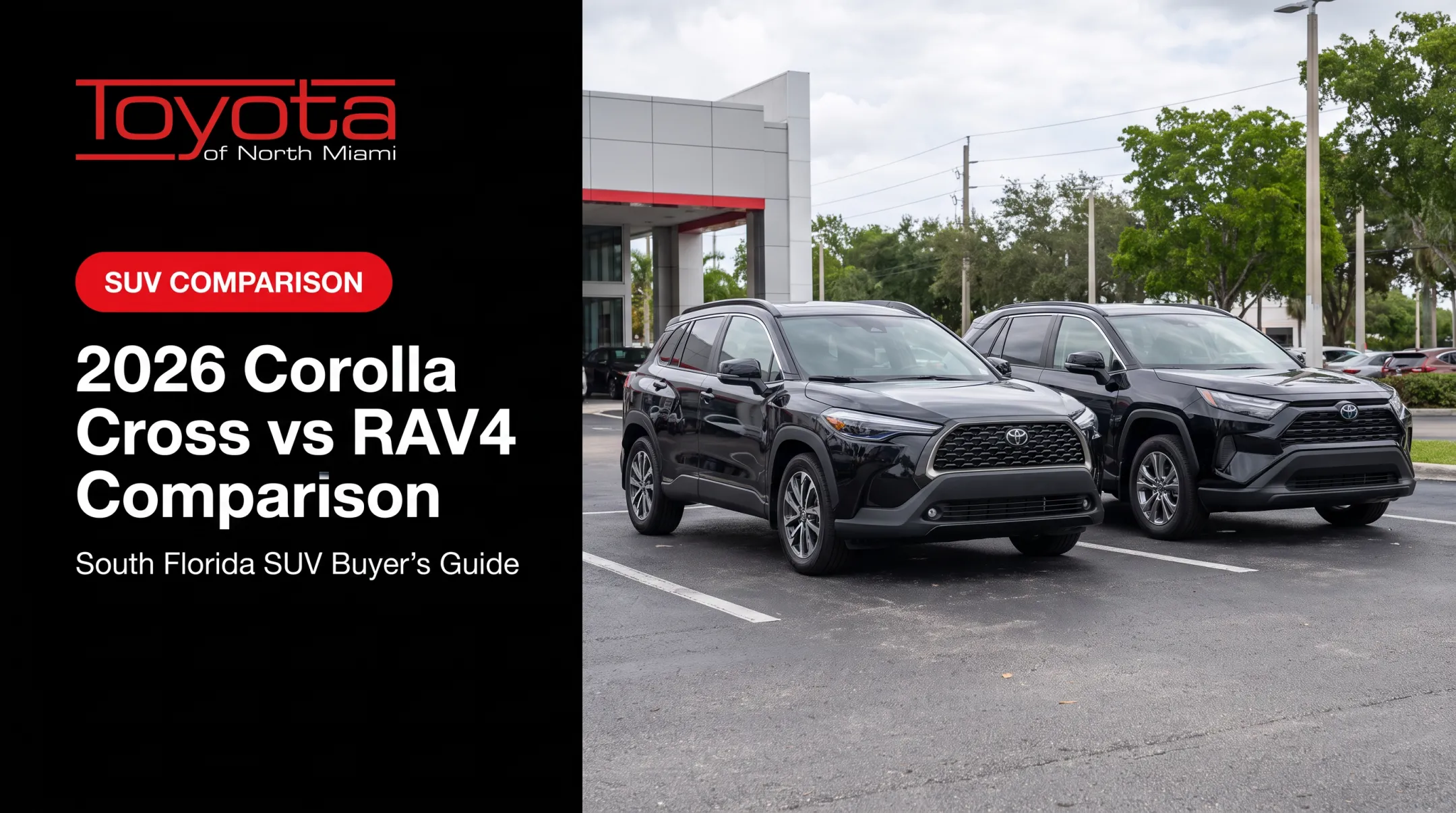
Many shoppers struggle to decide because the choice isn't really about fuel economy. It's about cargo flexibility, how you get in and out, your parking situation, and what your daily routine actually looks like. The Corolla Hybrid delivers up to 50 combined mpg in its most efficient configuration, according to fueleconomy.gov's ratings, while the Corolla Cross Hybrid trades some of that efficiency for cargo room, ground clearance, and standard all-wheel drive.
This guide compares verified 2026 specs, pricing, and practical use cases side by side, so you can match the vehicle to your life instead of the other way around.
Key Takeaways
- Corolla Hybrid leads on efficiency, price, and a lower, more car-like driving feel.
- Corolla Cross Hybrid is stronger on cargo access, seating height, and standard AWD.
- Fuel economy, equipment, and pricing shift by trim, so compare like-for-like grades.
- Base the final call on driving mix, cargo habits, and parking needs.
2026 Corolla Cross Hybrid vs Corolla Hybrid: Quick Comparison
Body Style and Driving Position
The Corolla Cross Hybrid is a crossover through and through. It rides on compact-crossover proportions with a rear liftgate and roughly 8.0 to 8.1 inches of ground clearance.
The seating position sits high enough that Kelley Blue Book specifically calls out the raised driving view in its Cross Hybrid comparison. AWD is standard across every hybrid grade.
The Corolla Hybrid sticks to sedan fundamentals:
- Lower seating position with car-like handling
- Separate trunk instead of a hatch
- Standard front-wheel drive, with AWD optional only on LE and SE grades
- More compact footprint for tight parking spots and garages
Price and Trim Range
| Vehicle | Starting MSRP* | Grades |
|---|---|---|
| Corolla Hybrid LE FWD | $24,975 | LE, LE AWD, SE, SE AWD, XLE |
| Corolla Cross Hybrid S AWD | $29,795 | S, SE, XSE (all AWD) |
*Pricing excludes destination charges. Cross Hybrid's destination charge is currently $1,595; confirm current figures and any added packages with Toyota of North Miami before budgeting.
The gap between the two starting prices runs close to $4,800, which matters if you're cross-shopping entry-level grades.
Fuel Economy and Powertrain
Here's where the body styles really diverge. EPA-rated combined mpg for 2026 hybrid configurations:
| Configuration | City | Highway | Combined |
|---|---|---|---|
| Corolla Hybrid LE/XLE FWD | 53 | 46 | 50 |
| Corolla Hybrid LE AWD | 51 | 44 | 48 |
| Corolla Hybrid SE FWD | 50 | 43 | 47 |
| Corolla Hybrid SE AWD | 47 | 41 | 44 |
| Corolla Cross Hybrid (all grades) | 46 | 39 | 42 |
The Corolla Hybrid's 1.8-liter engine pairs with Toyota's fifth-generation hybrid system for 138 net combined horsepower. The Cross Hybrid uses a larger 2.0-liter engine and three electric motors for 196 net combined horsepower, which helps offset its extra weight but still lands below sedan-level efficiency.
Both use an electronically controlled CVT and regenerative braking that recovers energy during stops, which is why both feel smooth creeping through traffic.
Passenger and Cargo Practicality
Toyota's own specs show the Cross Hybrid with 21.5 cubic feet of cargo space behind the rear seats, expanding with the seats folded. The Corolla Hybrid's trunk measures a smaller 13.1 cubic feet by Edmunds' reporting.
For bulky items (strollers, sports gear, a second suitcase), the liftgate's wider opening makes loading easier than threading things through a trunk lid.
Rear legroom tells a different story, though:
- Corolla Cross Hybrid: 32.0 inches rear legroom
- Corolla Hybrid: roughly 34.8 inches by third-party measurement
So the Cross Hybrid's taller cargo hold doesn't automatically mean more room for rear passengers. Families hauling car seats and groceries may still prefer the hatch access, but anyone prioritizing rear-seat comfort should sit in both before deciding.

Technology, Safety, and Drivetrain
Both models come standard with Toyota Safety Sense 3.0, covering pre-collision braking with pedestrian detection, full-speed dynamic radar cruise control, lane tracing assist, and automatic high beams. Both also include standard wireless Apple CarPlay and Android Auto.
Where they differ:
- Corolla Hybrid: Blind Spot Monitor is standard across all grades
- Corolla Cross Hybrid: Blind Spot Monitor comes standard on SE and XSE, but check availability on the base S grade
- Corolla Cross Hybrid XSE adds parking assist with automatic braking, a feature not listed for the sedan lineup
- AWD is standard on every Cross Hybrid grade; it's optional only on Corolla Hybrid LE and SE
AWD helps with wet pavement and light snow, not off-road trails. Neither vehicle is built for serious off-roading, even with all-wheel drive engaged.
What Are the 2026 Corolla Cross Hybrid and Corolla Hybrid?
What Is the 2026 Corolla Cross Hybrid?
The Corolla Cross Hybrid is Toyota's compact hybrid crossover, positioned above the Corolla sedan for ride height and cargo versatility. It runs a 2.0-liter engine with three electric motors for 196 combined horsepower, standard Electronic On-Demand AWD, and EPA-rated 42 mpg combined across S, SE, and XSE grades.
Practical benefits:
- Taller seating position for easier entry and exit
- Hatchback loading for bulky or tall items
- Flexible cargo configurations with rear seats folded
Tradeoffs: A higher starting price near $29,795 and lower combined fuel economy than the sedan.
Who It Suits
- Buyers who regularly haul groceries, luggage, strollers, or recreational gear
- Drivers who want crossover flexibility without stepping up to a larger SUV
- Households that deal with mixed city, suburban, and occasional rough-pavement driving
Who Might Skip It
Solo commuters chasing the smallest footprint, the lowest purchase price, or maximum highway mpg will likely find the sedan a better match.
What Is the 2026 Corolla Hybrid?
The Corolla Hybrid is a compact sedan built around efficient commuting and predictable handling. Its 1.8-liter hybrid system produces 138 net combined horsepower, and top-rated LE and XLE FWD grades hit 50 mpg combined.
Standard equipment includes Toyota Safety Sense 3.0 and Blind Spot Monitor with Rear Cross-Traffic Alert across all grades. Higher trims like XLE add a 12.3-inch gauge display and 10.5-inch touchscreen, while LE sticks with smaller 7-inch and 8-inch screens.
Advantages: Better aerodynamics, easier parking in tight spaces, and a lower starting price around $24,975 before destination.
Limitation: A smaller trunk opening compared with the Cross Hybrid's liftgate.
Who It Suits
- Daily commuters and students prioritizing low running costs
- Small households that rarely haul oversized cargo
- Drivers who spend most of their time on paved roads and highways
Who Might Prefer the Cross Hybrid Instead
Buyers who frequently load tall or bulky items, want a higher seating position, or need standard AWD should look at the crossover.

2026 Corolla Cross Hybrid vs Corolla Hybrid: What Is Better?
Neither model wins across the board. The right pick depends on how you weigh efficiency against cargo flexibility.
Choose the Corolla Hybrid if:
- Maximum verified EPA efficiency matters most (up to 50 mpg combined)
- You want the lowest reasonable entry price
- Easier maneuverability in tight city spaces is a priority
Choose the Corolla Cross Hybrid if:
- Cargo flexibility and hatchback access top your list
- You want a higher seating position for visibility and easier entry
- Standard AWD matters for your climate or commute
City and Highway Considerations
Stop-and-go traffic favors either hybrid's regenerative braking. Long highway commutes tend to favor the sedan's better aerodynamics and higher combined mpg.
Tight parking garages and street parking favor the Corolla Hybrid's smaller footprint. Buyers dealing with wet or snowy roads may lean toward the Cross Hybrid's standard AWD.
Ownership Considerations
Both carry identical coverage:
- 3-year/36,000-mile basic warranty
- 5-year/60,000-mile powertrain coverage
- 10-year/150,000-mile hybrid battery warranty
Routine maintenance intervals run every 5,000 miles or six months for both. Confirm current financing rates, insurance quotes, and incentive offers before comparing total ownership costs, since these shift regularly.
Test-Drive Checklist
- Sit in the front and rear seats of both vehicles with your typical passengers
- Test child-seat or cargo fit using items you actually carry
- Compare trunk access versus liftgate opening with real luggage
- Check visibility and ride feel on a mixed city/highway route
- Confirm your target trim's exact feature list
- Get written pricing for comparable grades before deciding
Real-World Examples
Car and Driver's test of a 2026 Corolla Cross Hybrid XSE AWD recorded these real-world results:
- 35 mpg observed in mixed driving
- 7.6 seconds to 60 mph
- Easy parking and grocery-friendly cargo room
That's a useful data point, even though it runs below the EPA's 42-mpg combined rating.

On the sedan side, Edmunds' 2026 review flagged price and fuel economy as the Corolla Hybrid's strongest traits. The tradeoffs are a smaller trunk and tighter rear legroom. For a commuter logging mostly highway miles with light cargo needs, that tradeoff tends to pay off at the pump.
If you're weighing trims, trade-in value, or financing on either model, Toyota of North Miami's online tools let you compare configurations, estimate payments, and get a trade-in value before you ever step onto the lot.
Conclusion
Pick the 2026 Corolla Hybrid if sedan efficiency, easy maneuverability, and a lower price matter most. Pick the 2026 Corolla Cross Hybrid if you need liftgate cargo access, a taller seating position, or standard AWD.
Either way, compare equivalent trims, verify current EPA and pricing figures, and bring your actual passengers and cargo along for a test drive at Toyota of North Miami before you sign anything.
Frequently Asked Questions
Is the Corolla Cross Hybrid better than the Corolla Hybrid?
Neither is universally better. Choose the Cross Hybrid for crossover utility and cargo access, or the Corolla Hybrid for sedan efficiency, maneuverability, and a lower starting price.
Which gets better gas mileage, the 2026 Corolla Cross Hybrid or Corolla Hybrid?
The Corolla Hybrid leads, reaching up to 50 mpg combined on LE and XLE FWD grades. The Cross Hybrid is rated at 42 mpg combined across all its grades.
Does the 2026 Corolla Cross Hybrid have more cargo space than the Corolla Hybrid?
Yes. Toyota lists 21.5 cubic feet behind the Cross Hybrid's rear seats versus roughly 13.1 cubic feet in the Corolla Hybrid's trunk, plus the liftgate opens wider for bulky items.
Is the Corolla Cross Hybrid available with all-wheel drive?
Yes, AWD is standard on every Cross Hybrid grade (S, SE, and XSE). It improves traction on wet or snowy roads but isn't designed for off-road use.
Which is more affordable, the Corolla Hybrid or Corolla Cross Hybrid?
The Corolla Hybrid starts lower, around $24,975 before destination, versus roughly $29,795 for the Cross Hybrid. Confirm current pricing, packages, and incentives before comparing final totals.
Should I buy the Corolla Hybrid or Corolla Cross Hybrid for commuting?
Choose the Corolla Hybrid for maximum efficiency and easy parking on a paved commute. Choose the Cross Hybrid if your commute also involves cargo, a taller seating position, or AWD needs.