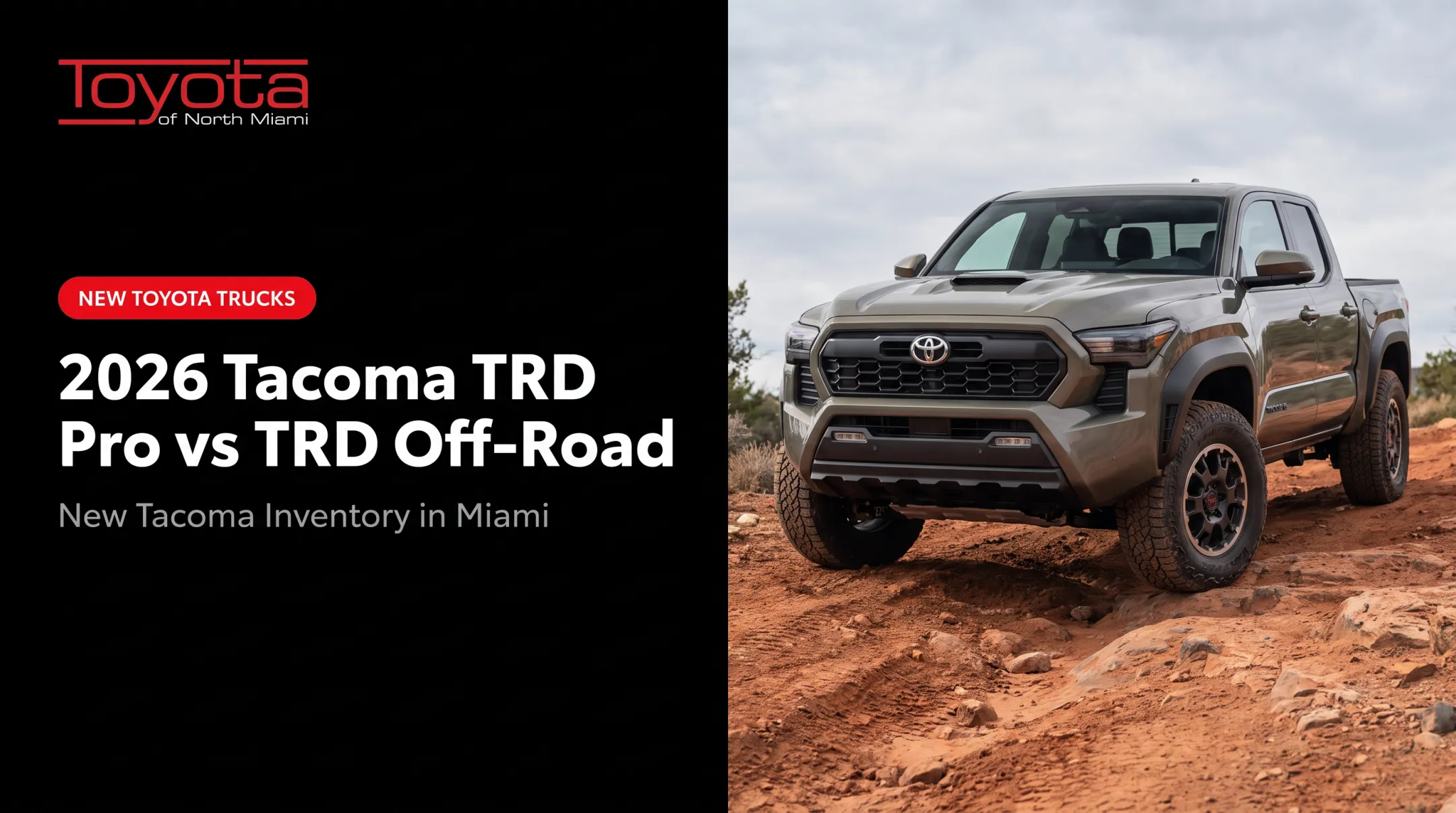
Both start with the same i-FORCE 2.4L turbocharged engine and an 8-speed automatic. But the similarities end there. Trim choice affects your upfront price, ride comfort, fuel economy, and whether you're paying for hardware you'll never use on a daily commute.
Model-year note: Features, pricing, and packages change year to year. Always confirm specs against current Toyota data or with your dealer before buying.
Key Takeaways
- SR5 offers better value and everyday versatility for commuters and families
- TRD Off-Road adds a locking rear differential, Crawl Control, and Bilstein shocks for serious trail work
- Base MSRP spans roughly $36,635 to $42,815 before options or destination
- Fuel economy is close in matched 4WD configurations, but highway mpg favors SR5 slightly
- Always compare matching cab, bed, and drivetrain configurations, not just trim badges
Toyota Tacoma SR5 vs TRD Off-Road: Quick Comparison
Trim Purpose
The SR5 is Toyota's balanced, broadly useful Tacoma. It covers commuting, hauling mulch, and the occasional gravel road without charging you for specialized trail gear.
The TRD Off-Road exists for a different mission. It's engineered to improve traction, control, and durability when the pavement runs out: think rutted forest roads, loose sand, or steep descents.
Everyday Comfort and Technology
Both trims share Toyota Safety Sense 3.0 standard, including pre-collision braking, lane tracing assist, and adaptive cruise control. That's a model-wide feature, not a trim upgrade.
Where they diverge:
- SR5: 8-inch Toyota Audio Multimedia display, 6-speaker audio, fabric-trimmed seats, 6-way manual seat adjustment
- TRD Off-Road: 14-inch Toyota Audio Multimedia display (per current listings), automatic climate control, 12.3-inch digital gauge cluster, Boulder/Black fabric with Smoke Silver interior trim
The TRD Off-Road's bigger screen and digital cluster give it a more modern cockpit feel. If in-cab tech matters to you daily, that's worth noting before you assume both trims feel the same inside.
Off-Road Hardware and Driving Systems
This is where the trims genuinely split. The TRD Off-Road brings:
- Electronically controlled locking rear differential for keeping both rear wheels turning on low-traction surfaces
- Multi-Terrain Select (MTS) to adjust throttle and traction response for sand, mud, or rock
- Crawl Control (CRAWL) for controlled low-speed descents or climbs without touching the pedals
- Downhill Assist Control (DAC) to manage speed on steep grades
- All-terrain tires and 17-inch TRD Off-Road alloy wheels
- Composite front skid plate protecting the transfer case and fuel tank
On loose sand, the locking differential keeps you moving when one wheel loses grip. On a rutted descent, Crawl Control lets you focus on steering while the truck manages throttle and brake. These aren't badge-only features. They change how the truck behaves when the surface gets unpredictable.

The SR5's equivalent equipment for these scenarios isn't documented as available, so don't assume you can option your way into locker-and-Crawl capability on an SR5.
Performance, Towing, Payload, and Drivetrain
Both trims use the same i-FORCE 2.4L turbo four-cylinder with an 8-speed automatic. Toyota's headline output is up to 278 hp and 317 lb-ft, though exact figures can shift by configuration.
Both are available with 4WDemand part-time 4WD, using an electronically controlled two-speed transfer case with high and low range. The TRD Off-Road also offers a 6-speed manual (iMT) for drivers who want more control on technical terrain (not available on the SR5).
Towing and payload numbers vary significantly by cab, bed, engine, and equipment. Neither trim has a single universal rating. Before you commit to a configuration for towing a trailer or camper, pull the exact rating for your specific build from Toyota's configurator or ask your dealer to confirm it in writing.
Ownership Value and Appearance
Toyota's displayed base MSRP sits at $36,635 for SR5 and $42,815 for TRD Off-Road gasoline, according to Toyota's 2026 Tacoma page. That's a roughly $6,000 gap before options, packages, or destination charges.
Real-world listings at Toyota of North Miami show the spread holds up in similarly equipped Double Cab trucks. SR5 4WD models land in the low-to-mid $40,000s, while TRD Off-Road 4WD pricing climbs toward $48,000 depending on equipment.
Wheel and tire packages differ too. SR5 rides on 17-inch styled alloy wheels. TRD Off-Road gets 17-inch TRD Off-Road alloys paired with all-terrain rubber, and higher packages add 18-inch TRD wheels with 32-inch Goodyear all-terrain tires.
If you plan to add off-road equipment later, the TRD Off-Road's factory-integrated hardware is typically cheaper than retrofitting a locker and skid plates yourself.
What Is the Toyota Tacoma SR5?
The SR5 is Toyota's mainstream Tacoma trim, built to balance capability, comfort, and price for buyers who don't need specialized trail equipment.
Standard equipment includes:
- i-FORCE 2.4L turbo engine with 8-speed automatic
- Class-IV towing hitch receiver with 7-pin/4-pin wiring harness
- 60/40 split-folding rear seats with under-seat storage
- Deck rail system with four adjustable tie-down cleats
- LED headlights, fog lights, and bed lighting
- Smart Key with push-button start
Dealer notes describe the SR5 as having a well-tuned suspension and stability control that deliver a composed ride, matching its daily-driver-first positioning rather than a trail-rig brief.
Use Cases of the Tacoma SR5
The SR5 fits buyers whose routine is mostly pavement with occasional detours: campsites, beaches, construction sites, or graded dirt roads.
Scenario: A family in Miramar needs a truck for the weekday commute, weekend hardware-store runs, and the occasional dirt-road drive to a lake house. They want decent fuel economy (21/26 mpg city/highway in RWD configurations), comfortable seats, and a reasonable price without paying for a locking differential they would use twice a year. The SR5 covers that mix without the TRD Off-Road price premium.
Where the SR5 falls short:
- No factory locking differential
- No Crawl Control
- No specialized dampers
If your weekends regularly involve rutted trails or rock ledges, you will feel the gap.
What Is the Toyota Tacoma TRD Off-Road?
The TRD Off-Road is built for drivers who regularly face rough, loose, or steep terrain and want factory-grade capability rather than aftermarket add-ons.
Verified 2026 equipment includes:
- Electronically controlled locking rear differential
- Multi-Terrain Select and Crawl Control
- Downhill Assist Control
- Independent double-wishbone front suspension, coil-spring multi-link rear
- Composite front skid plate with transfer-case and fuel-tank protection
- 17-inch TRD Off-Road alloy wheels with all-terrain tires
What these systems actually do:
- Multi-Terrain Select adjusts throttle mapping and traction intervention for the surface you're on, loosening things up for sand and tightening for mud
- Crawl Control works like low-speed cruise control on descents, managing brake and throttle so you can focus on steering around obstacles
On the highway, the TRD Off-Road trades some ride smoothness for trail capability. All-terrain tires generate more road noise than the SR5's standard rubber, and the firmer suspension tuning (built to handle rock impacts) can transmit more feedback over expansion joints and rough pavement.
It's not harsh, but it's noticeably different from the SR5's tuned-for-comfort setup.
A July 2026 Autoblog review of a manual-transmission TRD Off-Road described the clutch as light and predictable, calling the truck capable off-road with a "reasonably comfortable" everyday ride (Autoblog's 2026 review). That's a solid data point, though it doesn't include a direct SR5 comparison.

Use Cases of the Tacoma TRD Off-Road
This trim is built for campers, hunters, anglers, and overlanding enthusiasts who regularly travel unpaved or remote access roads.
Scenario: A buyer who tows a small camper to dispersed campsites every other weekend, then drives a mile of rutted forest road to reach the site. Factory Crawl Control and the locking differential handle that last stretch without requiring aftermarket upgrades.
Buying this equipment pre-installed is typically more cost-effective than adding a locker and skid plates after purchase, though any later modifications still need compatibility checks with your specific configuration.
The trade-off: higher upfront cost, firmer ride, and tires that generate more noise on long highway stretches.
Tacoma SR5 vs TRD Off-Road: What Is Better?
There's no universal winner here. Run through this quick framework:
- How often do you leave pavement? Weekly trail use favors TRD Off-Road. Occasional gravel roads favor SR5.
- What's your comfort priority? SR5's standard suspension rides smoother on daily commutes.
- Do you need to tow or haul regularly? Compare matching configurations — don't assume one trim tows more by default.
- What's your budget? The roughly $6,000 base-price gap matters if you're financing.
- Do you plan to modify the truck later? TRD Off-Road's factory hardware often beats aftermarket costs.
Choose SR5 if you want lower entry cost, broad configuration flexibility, and a truck that's equally happy commuting and running weekend errands.
Choose TRD Off-Road if you'll regularly put the locking differential, Crawl Control, and skid plates to actual use.
Real-World Examples and Shopping Scenarios
| Buyer Type | Better Fit | Why |
|---|---|---|
| Mostly-pavement commuter | SR5 | Lower price, smoother ride, no unused hardware |
| Weekend camper on maintained roads | SR5 | Occasional gravel doesn't require a locker |
| Frequent trail driver | TRD Off-Road | Locking diff, Crawl Control, skid plates get regular use |
| Buyer planning future modifications | TRD Off-Road | Factory integration beats retrofitting aftermarket parts |
Ready to compare these trims in person? Toyota of North Miami carries current SR5 and TRD Off-Road inventory, with configuration-specific pricing, trade-in valuation, and financing options available. Schedule a test drive to feel the ride difference firsthand before deciding.
Conclusion
The Tacoma SR5 is the sensible starting point for buyers who need a versatile daily truck without paying for specialized trail hardware. The TRD Off-Road earns its price premium for drivers who'll actually use the locking differential, Crawl Control, and skid plates on a regular basis.
The right choice depends on your exact configuration — drivetrain, cab, bed, engine, and intended terrain. Compare similarly equipped trucks rather than relying on trim names alone, and verify every spec against the current model year before signing anything.
Frequently Asked Questions
Which is better: the Toyota Tacoma SR5 or TRD Off-Road?
The SR5 typically wins on value and daily versatility, while the TRD Off-Road wins for frequent trail driving. The right pick depends on your model year, configuration, and how often you'll actually leave pavement.
What is the biggest difference between the Toyota Tacoma SR5 and TRD Off-Road?
The TRD Off-Road adds a locking rear differential, Multi-Terrain Select, Crawl Control, Bilstein-type shocks, and underbody skid plates. Availability of these features depends on the current model year, so confirm specs before buying.
Is the Toyota Tacoma SR5 worth buying?
Yes, for buyers who want Tacoma capability, standard safety tech, and solid towing hardware without paying for off-road equipment they won't use. It's priced roughly $6,000 lower at base MSRP than the TRD Off-Road.
Does the Tacoma TRD Off-Road have better off-road capability than the SR5?
Yes. It adds a locking rear differential, Crawl Control, Downhill Assist Control, and a composite skid plate not offered on the SR5. These systems improve traction and control on rough terrain.
Is the Tacoma SR5 or TRD Off-Road better for daily driving?
The SR5 generally rides smoother and quieter thanks to its standard tires and suspension tuning. The TRD Off-Road's all-terrain tires and firmer setup are built for trail capability, which can mean more road noise on daily commutes.
Can the Tacoma SR5 tow as much as the TRD Off-Road?
Towing capacity depends on engine, drivetrain, cab, bed, and transmission rather than trim name alone. Compare official ratings for matching configurations through Toyota's build tool or your dealer before assuming either trim tows more.