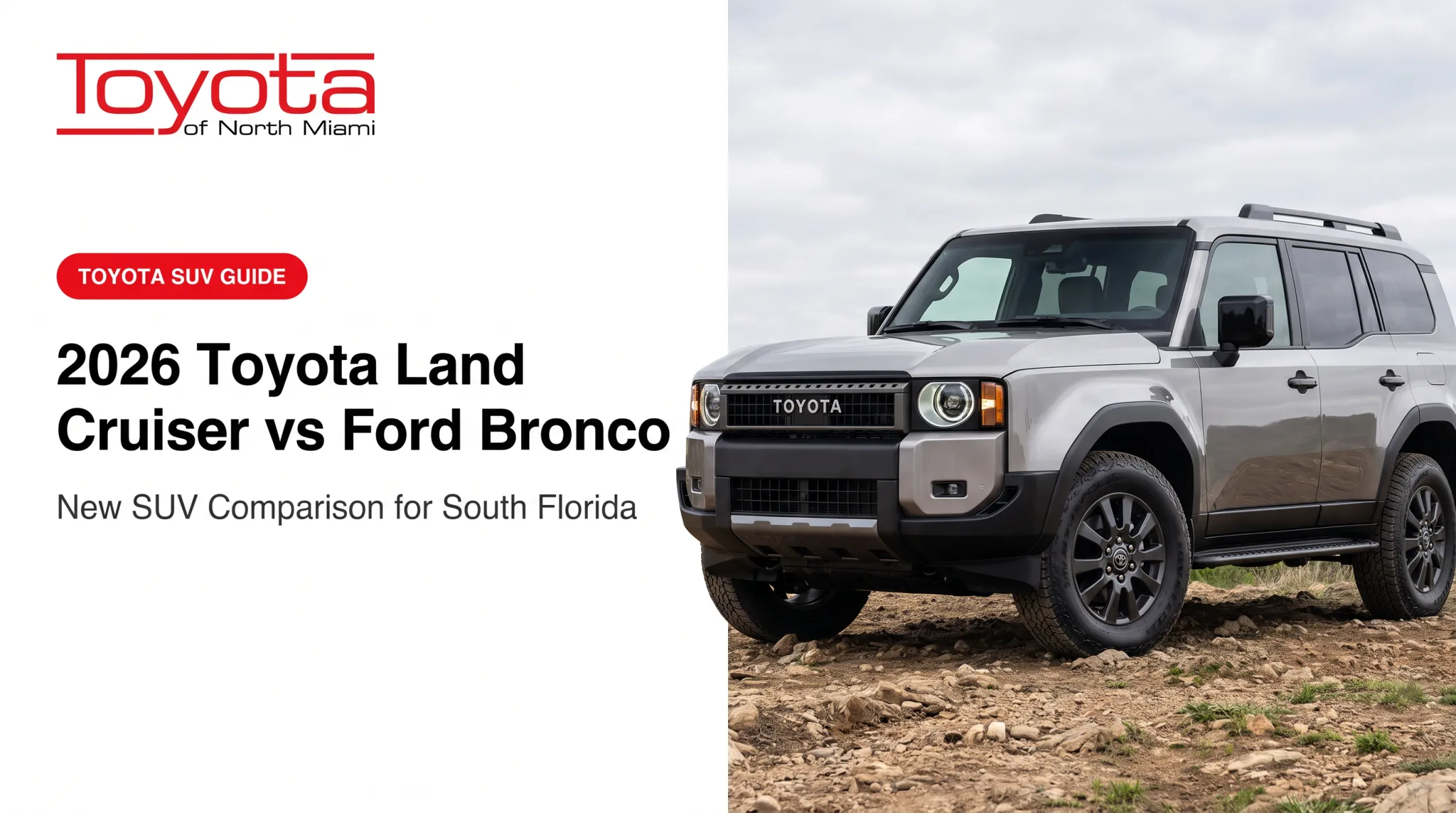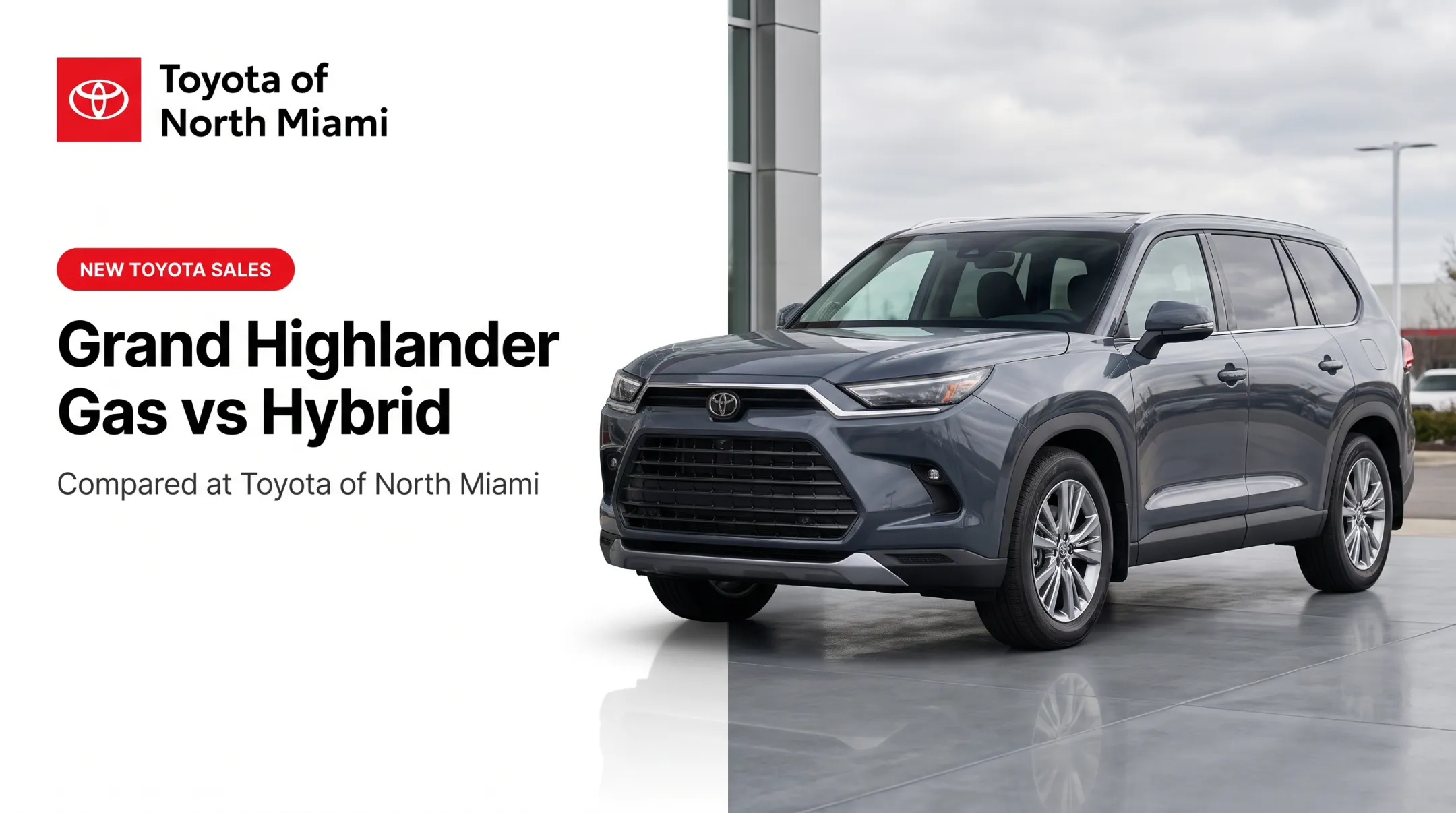

These two SUVs solve different problems. The Grand Highlander starts at $42,260 and is built around passenger room, cargo flexibility, and efficient hybrid powertrains. The Land Cruiser starts at $57,600 and is built around a body-on-frame chassis, locking differentials, and a 6,000-pound tow rating.
Neither is universally "better." The right pick depends on how you actually drive — school runs and road trips, or gravel roads and trailheads. This guide compares verified 2026 U.S. specifications so you can see exactly where each vehicle wins before test-driving both at Toyota of North Miami.
Key Takeaways
- Grand Highlander seats up to 8, offers three powertrains, and starts at $42,260, built for families who need room and efficiency
- Land Cruiser pairs full-time 4WD with locking differentials and a 6,000-lb tow rating, built for trail and towing duty
- "Bigger" depends on the measurement: Grand Highlander wins cargo and passenger count, Land Cruiser wins chassis strength
- Daily driving patterns matter more than horsepower when choosing between them
- Verify exact trims, drivetrains, and pricing since figures shift by configuration
2026 Grand Highlander vs. Land Cruiser: Quick Comparison
| Spec | Grand Highlander | Land Cruiser |
|---|---|---|
| Starting MSRP | $42,260 | $57,600 |
| Body construction | Unibody crossover | TNGA-F body-on-frame |
| Seating capacity | Up to 8 (7 with captain's chairs) | Confirm current capacity with our team* |
| Powertrain options | 2.4L turbo gas, 2.5L hybrid, 2.4L turbo Hybrid MAX | 2.4L turbo i-FORCE MAX hybrid only |
| Drivetrain | FWD or AWD, by trim | Full-time 4WD, standard |
| Max towing | 5,000 lb (gas/Hybrid MAX) or 3,500 lb (hybrid) | 6,000 lb |
| EPA combined mpg | 22–36, depending on powertrain | 23 |
| Max cargo volume | 97.5 cu ft | Confirm current figures with our team* |
| Ground clearance | 8.0 in. | Confirm current figures with our team* |
| Safety suite | Toyota Safety Sense 3.0 | Toyota Safety Sense 3.0 |
*Toyota's published 2026 Land Cruiser materials don't list every dimension yet. Ask our sales team for the latest spec sheet.
Size and Packaging: More Than a Length Number
The Grand Highlander measures 201.4 inches long, 78.3 inches wide, and 72.1 inches tall on a 116.1-inch wheelbase. Toyota rates passenger volume at 149 cubic feet with the panoramic moonroof (153.3 without it), and the third row offers 33.5 inches of legroom, enough for adults on shorter trips.
If cabin space is your top priority, sit in both vehicles before deciding. Toyota hasn't published matching exterior dimensions for the 2026 Land Cruiser in the materials reviewed here.
Performance and Efficiency
Pick your Grand Highlander powertrain based on priorities. The 2.4L turbo gas makes 265 hp and 310 lb-ft. The 2.5L hybrid trades some punch for up to 36 mpg combined. The Hybrid MAX delivers 362 hp and 400 lb-ft, Toyota's quickest Grand Highlander yet.
The Land Cruiser only comes one way: a 2.4L turbo i-FORCE MAX hybrid making 326 hp and 465 lb-ft, paired with full-time 4WD and a locking center differential. Edmunds' Land Cruiser test clocked it at 8.3 seconds to 60 mph, quick for a body-on-frame SUV. The same review flagged soft handling and less confident emergency braking than expected.

Ownership value: The Land Cruiser carries extended hybrid coverage (8 years/100,000 miles on hybrid components and 10 years/150,000 miles on the battery) plus 2 years/25,000 miles of complimentary ToyotaCare maintenance. Confirm matching figures for your specific Grand Highlander trim when you finance or lease.
What Are the 2026 Grand Highlander and Land Cruiser?
Both wear Toyota badges, but they're engineered for opposite priorities.
Grand Highlander: The Family-First Crossover
The Grand Highlander is Toyota's largest three-row crossover, built on a unibody platform rather than a truck frame. That matters for ride comfort: it drives more like a tall car than a truck.
Seating varies by trim:
- LE: 8-passenger, 60/40 bench second row
- XLE, Limited, Platinum: available 7-passenger layout with second-row captain's chairs
- All trims: 60/40 split third row with recline and sliding headrests
Three powertrains let you match efficiency to your driving style:
- 2.4L turbo gas (265 hp) for buyers who want AWD without a hybrid premium
- 2.5L hybrid (245 net hp, up to 36 mpg combined) for high-mileage commuters
- 2.4L turbo Hybrid MAX (362 hp, 400 lb-ft) for families who want quicker merging and up to 5,000 lb of towing
Every Grand Highlander ships with Toyota Safety Sense 3.0, a 12.3-inch touchscreen with wireless Apple CarPlay and Android Auto, and three-zone climate control with second-row vents. Limited and Platinum trims add an 11-speaker JBL audio system and a panoramic view monitor.
What it isn't: a trail rig. There's no low-range transfer case, and the Hybrid MAX's Multi-Terrain Select is tuned for mud, sand, and dirt roads, not rock crawling. For a family hauling strollers and luggage for a beach week, that trade-off rarely matters.
Land Cruiser: Built for the Trail
The Land Cruiser returns to the U.S. as a body-on-frame SUV on Toyota's TNGA-F truck platform — the same architecture under the Tundra and Sequoia.
Every 2026 Land Cruiser uses the 2.4L turbo i-FORCE MAX hybrid (326 hp, 465 lb-ft) with full-time 4WD, according to Toyota's Land Cruiser release. Standard hardware includes:
- Torsen limited-slip center differential with locking capability
- Locking rear differential
- CRAWL Control and Downhill Assist Control
- Multi-Terrain Select and Multi-Terrain Monitor (Land Cruiser grade)
- Two-speed transfer case (1958 grade)
Inside, the cabin pairs durability with comfort: Toyota Safety Sense 3.0, available JBL audio, and the hybrid architecture shared with the Tundra and Sequoia. Toyota hasn't published full 2026 seating and cargo figures yet, so confirm exact capacity before comparing it directly against the Grand Highlander.
For buyers who tow a camper, drive gravel to a hunting lease, or want serious trail hardware, that trade-off makes sense. For buyers whose roughest terrain is a parking garage ramp, the capability (and higher starting price) may be more than necessary.
Which Is Better for You?
The honest answer: it depends on how you use the vehicle, not which one has more horsepower.
Choose the Grand Highlander if you:
- Need seven or eight seats for carpools, grandparents, or sports teams
- Want hybrid efficiency for a long commute (up to 36 mpg combined)
- Pack for family trips often and need up to 97.5 cubic feet of cargo
- Tow a small trailer or boat occasionally (up to 5,000 lb)
- Prioritize a lower starting price and easier parking in tight garages
Choose the Land Cruiser if you:
- Regularly drive unpaved or rutted roads
- Need locking differentials and low-range gearing for technical trails
- Tow heavier loads close to 6,000 lb
- Value a body-on-frame chassis built to take a beating
- Accept a smaller seating footprint for that capability
Don't Overlook the 4Runner
If neither extreme fits, the 4Runner sits in between. It starts at $42,270, seats up to seven with an available third row, and offers up to 90.2 cubic feet of max cargo. Like the Land Cruiser, it's body-on-frame with up to 10.1 inches of ground clearance, but priced closer to the Grand Highlander. Its i-FORCE MAX hybrid makes the same 326 hp and 465 lb-ft as the Land Cruiser's engine. Part-time or full-time 4WD is available depending on trim.
Matching Towing Ratings to Real Trailers
A maximum rating isn't what you'll actually tow. A pop-up camper or small utility trailer rarely tops 3,500 lb, well within Grand Highlander Hybrid range. A loaded travel trailer or a larger boat can push past 5,000 lb, where the Land Cruiser's 6,000-lb rating adds real margin.

The checklist: more carpools than campsites, the Grand Highlander wins. More off-road gear than car seats, the Land Cruiser earns its price tag.
Real-World Example: A Family Road Trip
Kelley Blue Book's Robert Duffer put a 2026 Grand Highlander Hybrid through an actual long-weekend trip with his adult children, documented in KBB's road-trip review.
The need: comfortable seating for adults, not just kids, over hours of highway driving.
The result: the second-row captain's chairs and front passenger seat earned no complaints, even from grown children. Two adults squeezed into the third row for short stretches, but Duffer couldn't convince them to stay there for the full six-hour drive.
The takeaway: the Grand Highlander's second row is genuinely adult-friendly, but the third row works best for kids, shorter adults, or shorter trips. If your family fills all three rows for long hauls, test that seat yourself.
That kind of detail is hard to judge from a spec sheet, which is why it helps to see both vehicles in person. Browse our current Grand Highlander inventory and schedule a back-to-back test drive with Toyota of North Miami to see which cabin and capability fit your life.

Conclusion
The better pick depends on your driving pattern. The Grand Highlander covers school runs, airport trips, and family vacations with three rows, flexible seating, and hybrid efficiency starting at $42,260.
The Land Cruiser trades some of that flexibility for full-time 4WD and a 6,000-lb tow rating starting at $57,600.
Confirm current pricing and trim availability before you commit, since figures shift through the model year. Then get behind the wheel. A spec sheet won't tell you how either SUV feels on your commute or your favorite trail. Visit Toyota of North Miami to compare both in person.
Frequently Asked Questions
Is the Toyota Land Cruiser bigger than the Grand Highlander?
Not in every way. The Grand Highlander offers more passenger volume, a usable third row, and 97.5 cubic feet of max cargo. The Land Cruiser's advantage is chassis strength and ground clearance, so "bigger" depends on what you're measuring.
Which is better for me: Grand Highlander, 4Runner, or Land Cruiser?
Pick the Grand Highlander for family hauling and hybrid efficiency, the 4Runner for a middle ground near $42,270, and the Land Cruiser for the most dedicated 4WD hardware. Match the vehicle to how often you'll use that capability.
What is the main difference between the 2026 Grand Highlander and Land Cruiser?
The Grand Highlander is a unibody crossover built around seating flexibility and efficient powertrains. The Land Cruiser is a body-on-frame SUV built around full-time 4WD and off-road hardware like locking differentials.
Does the 2026 Grand Highlander have better fuel economy than the Land Cruiser?
Yes, in hybrid form. The Grand Highlander Hybrid reaches up to 36 mpg combined versus the Land Cruiser's 23 mpg combined. The gas Grand Highlander and Hybrid MAX trims post lower, closer figures.
Which Toyota SUV has more seating and cargo space?
The Grand Highlander seats up to eight and offers 97.5 cubic feet of max cargo with the rear rows folded. Toyota's current 2026 Land Cruiser materials don't publish matching figures, so confirm those in person.
Is the Land Cruiser better for towing and off-roading than the Grand Highlander?
For serious trails and heavier loads, yes: its 6,000-lb tow rating and locking differentials outclass the Grand Highlander. If you tow occasionally under 5,000 lb or stick to maintained roads, the Grand Highlander's Hybrid MAX is plenty.