Many shoppers assume a hybrid's tow rating comes down to horsepower alone. It doesn't. Toyota's published maximum reflects a complete system: drivetrain, trim, curb weight, payload allowance, cooling capacity, brakes, hitch hardware, and the trailer itself all factor into the number stamped in the owner's manual.
This guide breaks down 2026 Toyota hybrid towing capacity model by model, explains how ratings differ even within the same nameplate, and covers the specification checks and safe towing habits that keep your combination legal and controllable.
Key Takeaways
- Toyota hybrid tow ratings vary by model, trim, and drivetrain, so never apply one hybrid's number to another.
- 2026 figures run from roughly 1,750 lbs on RAV4 Hybrid SE FWD to 9,500 lbs on Sequoia i-FORCE MAX.
- Payload, tongue weight, GVWR, and GCWR are separate limits that all apply at the same time.
- Confirm your exact vehicle and trailer combination against the owner's manual before every trip.
What Toyota Hybrid Towing Capacity Really Means
Towing capacity is the maximum trailer weight your Toyota is engineered and certified to pull when properly equipped and operated under Toyota's stated conditions. Treat that figure as a hard system limit set by the hybrid powertrain, transaxle, cooling system, chassis, suspension, tires, brakes, hitch receiver, and stability controls working together.
The Ratings That Define the Limit
Several weight figures apply simultaneously, and mixing them up is the most common towing mistake:
- Trailer weight rating (TWR): maximum weight of the trailer itself
- Payload / load carrying capacity: weight of passengers, cargo, and accessories the vehicle can carry
- Gross vehicle weight rating (GVWR): maximum allowable weight of the loaded vehicle alone
- Gross combined weight rating (GCWR): maximum allowable weight of vehicle and trailer combined
- Tongue weight: downward force the trailer places on the hitch ball, not the trailer's full weight
A legal, safe combination satisfies every one of these ratings, not just the headline tow number. Toyota's current ratings follow the SAE's 2024 standard, which sets the testing method manufacturers use to calculate GCWR and TWR. That's a rating framework, not permission to exceed what's published for your specific build.
One more distinction matters here. "Hybrid" isn't one category at Toyota. The 2026 lineup spans conventional hybrids (RAV4 Hybrid, Highlander Hybrid), plug-in hybrids (RAV4 Plug-in Hybrid), and i-FORCE MAX hybrid trucks and SUVs (Tacoma, Tundra, 4Runner, Sequoia). Treating these as interchangeable is where a lot of online tow-rating confusion starts.
What Actually Changes the Number
A few variables shift the published maximum even within the same nameplate:
- Drivetrain: RAV4 Hybrid's FWD and AWD versions carry different tow ratings entirely
- Trim and curb weight: extra equipment or a larger battery pack can reduce available payload
- Hitch and wiring: receiver rating, connector type, and whether trailer brakes are wired in
- Trailer configuration: load distribution, tire condition, and trailer shape all affect real-world handling
- Environment: hills, heat, wind, and stop-and-go traffic add stress without changing the printed rating
A lab test assumes ideal conditions. A mountain pass in August, with a full load of cargo and a tired set of tires, doesn't match that test, even though the number on paper hasn't moved.
2026 Toyota Hybrid Towing Capacity by Model
The spread is wide on purpose. Toyota builds hybrids for buyers who want efficiency first, like RAV4, Highlander, and Crown Signia, and hybrids built for buyers who need serious capability, like 4Runner and Sequoia i-FORCE MAX. Here's where the verified 2026 maximums land:
| 2026 Model | Hybrid Type | Verified Max Tow Rating | Trim/Drivetrain Note |
|---|---|---|---|
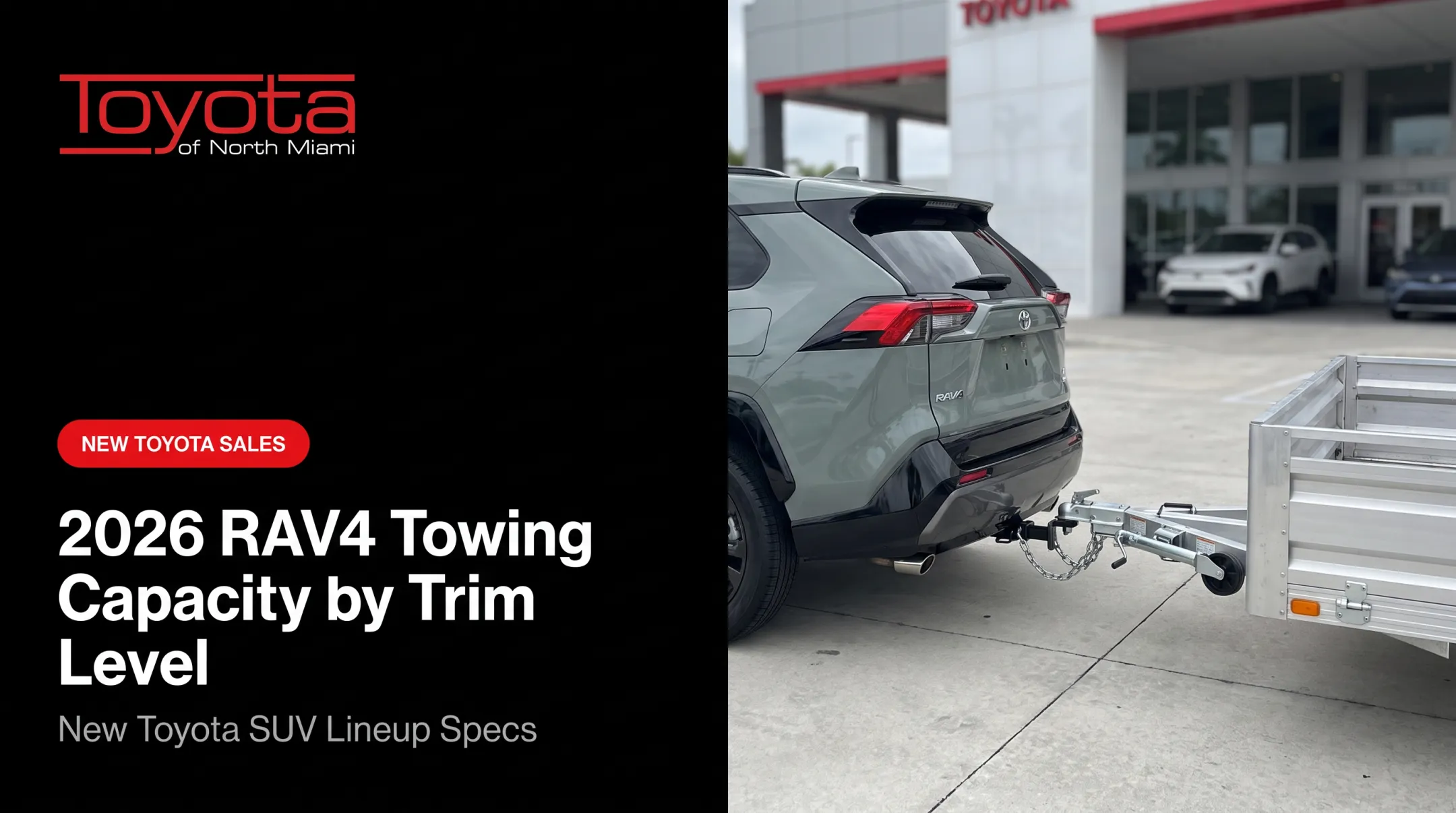
| RAV4 Hybrid | Conventional hybrid | 1,750–3,500 lbs | 1,750 lbs on SE FWD; 3,500 lbs on SE AWD and most AWD grades |
| RAV4 Plug-in Hybrid | PHEV | Up to 3,500 lbs | Confirmed for Woodland AWD; other grades vary |
| Highlander Hybrid | Conventional hybrid | Up to 3,500 lbs | XLE, Limited, Platinum; standard AWD |
| Crown Signia | Conventional hybrid | 2,700 lbs | XLE and Limited, hybrid AWD |
| 4Runner i-FORCE MAX | Turbo hybrid | Up to 6,000 lbs | Hybrid-specific trim exceptions not published |
| Sequoia i-FORCE MAX | Twin-turbo V6 hybrid | Up to 9,500 lbs | Exact trim/drivetrain combo reaching this max not specified |

Highlander Hybrid now comes standard with all-wheel drive across the entire lineup for 2026, according to Toyota's Highlander announcement. That change simplifies the model's tow rating compared to lineups with mixed drivetrains.
Two gaps worth flagging. Grand Highlander's Hybrid and Hybrid MAX powertrains carry separate ratings that weren't published in full trim-level detail for 2026 at the time of writing. Don't assume the conventional hybrid's figure applies to Hybrid MAX, or the reverse.
The same caution applies to Tacoma and Tundra i-FORCE MAX. Toyota confirms both are available with hybrid powertrains, but hybrid-specific tow numbers by cab, bed length, and drivetrain weren't broken out in current documentation. Pull the certification label or owner's manual for your exact configuration before shopping against a number you saw online.
Matching Capacity to the Right Trailer
A tow rating only matters relative to what you're actually pulling, and loaded weight, not dry weight, is what counts:
- Utility or PWC trailer: include the trailer plus everything strapped to it
- Small camper or pop-up: add water, propane, and gear. These pile up faster than most buyers expect
- Boat trailer: count the boat, fuel, motor, and safety equipment together
- Travel trailer: get a certified scale reading loaded for a real trip, not the advertised dry weight
A vehicle rated for a given maximum isn't automatically the right fit for that maximum in every condition. Mountain grades, headwinds, and hot weather all eat into your margin, so building in reserve capacity based on your actual conditions beats towing right at the printed ceiling every time.
Safe Operating Margins and Hitch Requirements
Towing capacity has a floor as well as a ceiling. Too light a trailer, and weight-distributing or sway-control hardware may not work as designed. Too heavy, and you're past the rated limit. Both ends matter.
Toyota's manuals spell out hardware thresholds that change as trailer weight rises:
- Tongue weight: generally 9% to 11% of the loaded trailer's gross weight
- Trailer brakes: required once the trailer exceeds the vehicle's unbraked rating, 1,000 lbs on RAV4, for example
- Sway-control device: required above roughly 2,000 lbs on several models
- Weight-distributing hitch: required above 5,000 lbs on Tundra hybrid configurations
These aren't optional upgrades. They're the line between a compliant combination and one that technically exceeds what the vehicle is rated to handle.
How often you tow matters just as much. An occasional weekend trip with a light utility trailer puts far less stress on the hybrid system, brakes, and cooling components than repeated long-distance runs through mountains or summer heat.
Regular near-maximum towing means more heat buildup, more brake wear, and shorter intervals between service visits.
There's no Toyota-published universal buffer and no official "tow at 80% of max" rule. Actual available capacity depends on curb weight plus the cargo, passengers, and add-on equipment on board that day.
Build your own margin from your conditions and experience, and treat model-specific hitch and brake requirements as rules, not suggestions.
Key Technical Properties of Toyota Hybrid Towing Capacity
Towing capacity isn't a measure of horsepower or electric-motor torque alone. It's a constrained operating characteristic shaped by three properties working together.
Stability and Control
Wheelbase, suspension geometry, tire condition, electronic stability control, trailer-sway control, and correct tongue weight combine to keep a loaded trailer predictable at speed.
Toyota's Star Safety System works alongside Trailer-Sway Control on models like RAV4 and Sequoia to help manage a loaded trailer. It includes:
- Vehicle Stability Control
- Traction Control
- ABS
- Electronic Brake-force Distribution
- Smart Stop Technology
None of this replaces correct loading, though. A trailer loaded tongue-heavy or tail-heavy, hit with a crosswind, or towed too fast through a lane change can become unstable even when its weight sits comfortably below the printed maximum.
Thermal and Mechanical Load
Towing increases demand on the hybrid system, engine, transaxle, battery pack, cooling system, brakes, tires, and hitch hardware all at once. Sequoia's i-FORCE MAX pairs a twin-turbo V6 with a 288V nickel-metal hydride battery and water-cooled intercooling specifically to manage that added thermal load during sustained towing.
Maintenance guidance tightens up under frequent towing. The 2026 Tacoma's schedule, for instance, calls for a visual brake inspection every 5,000 miles and a thickness and runout check every 30,000 miles under normal use.
Towing-heavy driving warrants closer attention to those same intervals, even where Toyota doesn't publish a separate towing-specific schedule.
Variability and Configuration Dependence
The same model name can carry different ratings depending on model year, trim, drivetrain, battery configuration, and factory-installed equipment. RAV4 Hybrid's FWD-versus-AWD split, 1,750 lbs compared to 3,500 lbs, is the clearest 2026 example.
Rated capacity and usable capacity aren't the same thing, either. Once you subtract passengers, cargo, dealer-installed accessories, and tongue weight from payload, the trailer weight you can actually add often lands lower than the headline number suggests.
That's the real trade-off buyers face. A RAV4 Hybrid sips fuel but tops out around 3,500 lbs. A Sequoia i-FORCE MAX can clear 9,500 lbs at the cost of worse everyday efficiency. Pick based on what you're hauling, not the number that sounds biggest.

Specifying, Verifying, and Towing Safely
A tow rating works as both a shopping spec and a pre-trip safety check. Treat it as both, every time.
Confirm the Paper Trail
Before buying or towing, pull the documentation for your exact build:
- Toyota's official specifications or brochure for your model year and trim
- The owner's manual section covering towing and weight ratings
- The certification label on the driver's doorjamb, listing GVWR, GAWR, and tire specs
- Any tow-package documentation showing hitch receiver rating and wiring
Do the same for the trailer: confirm its GVWR, actual loaded weight, tongue weight, axle ratings, tire ratings, and brake requirements. A trailer that looks fine on a dealer lot can still exceed your vehicle's rating once it's packed for a trip.
Pre-Trip Checks That Actually Matter
NHTSA's towing guide recommends weighing the fully loaded combination at a public scale before a long trip. It's the only way to confirm your numbers match reality, not just the brochure.
Beyond the scale, run through this before leaving the driveway:
- Check the hitch - pin, coupler, safety chains, and wiring connections
- Inspect tires and brakes - on both vehicle and trailer, including the spare
- Confirm lights work - turn signals, brakes, running lights on the trailer
- Secure every load - cargo restrained, weight balanced side-to-side
- Scan warning indicators - hybrid system alerts before starting the engine
Toyota of North Miami's factory-trained service team can verify hitch and wiring compatibility for your exact configuration before towing season starts. They also handle the brake, tire, and fluid checks that frequent towing wears down faster than normal driving.
Once you're moving:
- Accelerate gradually
- Brake earlier than you would unloaded
- Take wider turns
- Leave extra following distance
Grades, rain, and crosswinds all call for a slower pace than you'd use solo.
Towing Beyond the Rating: Risks and Misconceptions
Pushing past a published rating doesn't just risk a ticket. It changes how the vehicle behaves. Overloaded combinations show up as:
- Reduced acceleration and longer braking distances
- Overheating in the engine, transaxle, or brakes
- Trailer sway that's harder to correct
- Accelerated wear on tires, suspension, and hitch components
- In the worst cases, loss of control
Warranty and insurance: Toyota lists misuse, including overloading, among warranty exclusions in its maintenance guides. That doesn't mean every towing trip voids an entire warranty, but overload-related damage specifically may fall outside coverage.
Trailer brake and breakaway equipment laws also vary by state, so check current requirements where you'll be driving.
A few misconceptions deserve direct correction:
- A hybrid's instant electric torque does not automatically raise its tow rating
- All-wheel drive does not guarantee higher capacity than a comparable FWD or RWD configuration
- Installing a hitch does not create a new, higher manufacturer rating; it only enables towing up to the existing one
- An online spec sheet, a dealer listing, or last year's model numbers should never replace your vehicle's owner's manual and certification label
Fuel economy takes a real hit under load, too. Toyota states towing can adversely affect fuel consumption, though no fixed percentage applies across every model and condition.
If you tow frequently, in heat, or across mountainous terrain, choose a more conservative trailer or a hybrid with more rating to spare. Running at the printed maximum trip after trip is a poor long-term bet.
Conclusion
Toyota hybrid towing capacity is a configuration-specific rating set by the complete vehicle-and-trailer combination, down to trim, drivetrain, and hitch hardware.
Before buying or hooking up for 2026, compare the verified model, trim, drivetrain, payload, and hitch requirements against your actual trailer, not a lineup-wide headline number.
If you're trying to match a Toyota hybrid to a specific towing need, Toyota of North Miami's sales and factory-trained service teams can walk through current model options and configuration-specific guidance for your situation.
Frequently Asked Questions
Which Toyota hybrids are capable of towing?
Several 2026 Toyota hybrids are tow-rated, including RAV4 Hybrid, RAV4 Plug-in Hybrid, Highlander Hybrid, Crown Signia, 4Runner i-FORCE MAX, and Sequoia i-FORCE MAX. Exact maximums vary by trim, drivetrain, and factory equipment.
Which RAV4 Hybrid can tow 3,500 lbs?
The 2026 RAV4 Hybrid reaches 3,500 lbs on SE AWD and most other AWD grades, while SE FWD is rated at 1,750 lbs. Confirm the figure against your exact trim and drivetrain combination.
How much can a Toyota hybrid tow?
It depends entirely on the model. 2026 ratings span roughly 1,750 lbs on efficiency-focused hybrids up to 9,500 lbs on Sequoia i-FORCE MAX. Check your specific model's owner's manual for the verified number.
Can a hybrid tow a camper or boat?
Yes, several Toyota hybrids can tow appropriately sized campers or boats. Check the trailer's fully loaded weight, tongue weight, your vehicle's payload, and hitch rating together before buying or hooking up.
Does towing affect a hybrid's fuel economy or maintenance?
Towing adds load and aerodynamic drag, which generally reduces fuel economy and increases wear on brakes, tires, and cooling components. Follow Toyota's maintenance schedule and towing guidance, especially on frequent or long-distance trips.