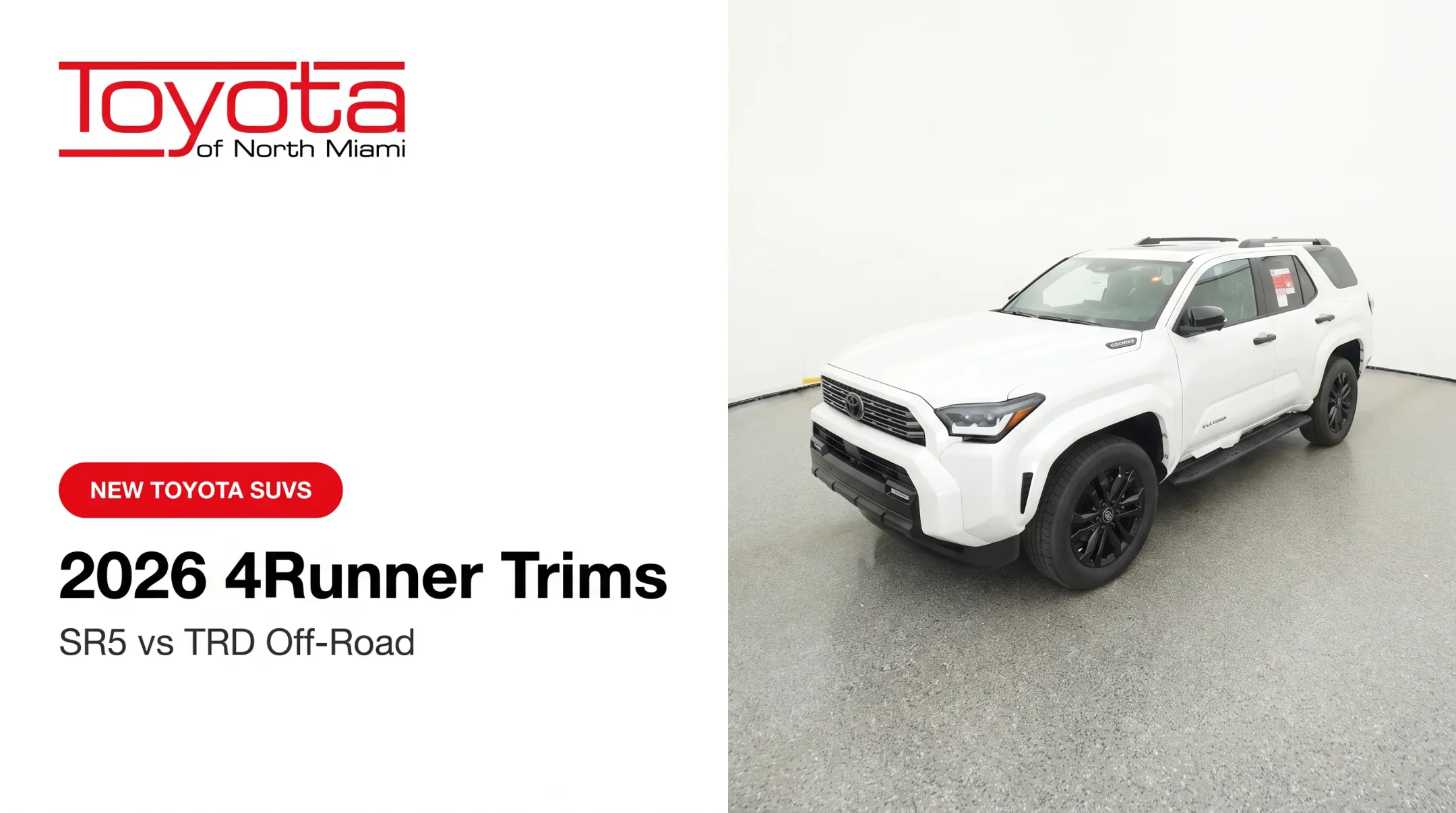
The bigger differences show up in purchase price, low-speed power, cargo packaging, towing feel, and which trims you can actually get. A buyer who tows a camper up a grade has different priorities than one who commutes 40 miles each way on I-95.
This guide compares verified 2026 specifications, pricing, and warranty terms for both powertrains, then walks through real-world use cases so you can match the drivetrain to how you actually drive.
Key Takeaways
- i-FORCE MAX hybrid earns its premium through power and low-speed torque, not fuel savings alone
- Standard i-FORCE gas often wins on upfront price and trim availability
- Both powertrains share the 4Runner's body-on-frame platform; off-road hardware still varies by trim
- Confirm current pricing, EPA ratings, and trim-specific equipment before you sign anything
Toyota 4Runner Hybrid vs Gas: Quick Comparison
Comparing the same trim wherever possible isolates the powertrain differences from equipment differences that come with moving up a grade.
Power and Torque
The i-FORCE MAX hybrid produces meaningfully more output than the standard engine, and the gap is biggest at low rpm.
| Powertrain | Horsepower | Torque | Hardware |
|---|---|---|---|
| i-FORCE gas | 278 hp @ 6,000 rpm | 317 lb-ft @ 1,700 rpm | 2.4L turbo inline-four, 8-speed automatic |
| i-FORCE MAX hybrid | 326 hp @ 6,000 rpm | 465 lb-ft @ 1,700 rpm | 2.4L turbo hybrid, 48-hp electric motor, 288V battery, 8-speed automatic |
That 148 lb-ft advantage comes largely from the electric motor's 184 lb-ft, which fills in instantly before the turbo spools. In practice, that means:
- Quicker launches from a stop in traffic
- Less hesitation on steep driveways or loading ramps
- Smoother low-speed crawling on technical trails
- More confident passing power when loaded with gear
The gas engine isn't slow. Its twin-scroll turbo still delivers solid mid-range pull, and the 8-speed automatic behaves the same way in both versions. It just doesn't have an electric motor filling the gap before boost arrives.
Fuel Economy
Toyota's brochure projects 23/24/23 mpg (city/highway/combined) for hybrid grades. EPA fuel economy data lists two separate hybrid 4WD entries, one at 23/24/23 and another at 22/24/23.
Gas model EPA ratings also vary by drivetrain:
- Gas 2WD: 20 mpg city / 26 mpg highway
- Gas 4WD: 19-20 mpg city / 24-25 mpg highway
- Hybrid 4WD: 22-23 mpg city / 24 mpg highway
The hybrid's advantage is clearest in stop-and-go traffic, where the electric motor handles more of the low-speed work. At steady highway speeds, the gap narrows considerably, and some gas 2WD configurations actually post a higher highway number. If your driving is mostly open road, don't assume the hybrid automatically wins at the pump.
Cost and Ownership Coverage
Pricing varies by trim, and the premium isn't uniform across the lineup. Toyota.com lists these matched comparisons:
| Trim | i-FORCE (gas) | i-FORCE MAX (hybrid) | Difference |
|---|---|---|---|
| TRD Off-Road | $50,690 | $53,490 | $2,800 |
| TRD Off-Road Premium | $56,470 | $59,270 | $2,800 |
| Limited | $56,900 | $61,700 | $4,800* |

*The Limited's gap is larger, but the gas Limited's exact drivetrain pricing isn't broken out in Toyota's published materials, so treat that figure as directional rather than a clean apples-to-apples premium.
Some grades don't offer a choice at all:
- Gas-only: SR5, TRD Sport, and TRD Sport Premium
- Hybrid standard: Platinum, TRD Pro, and Trailhunter
- Either engine: TRD Off-Road, TRD Off-Road Premium, and Limited
Hybrid system warranty coverage runs longer than the base powertrain terms:
- Basic coverage: 3 years/36,000 miles
- Powertrain: 5 years/60,000 miles
- Hybrid system components: 8 years/100,000 miles
- Hybrid battery: 10 years/150,000 miles
Longer coverage protects you against repair costs. It is not proof that the hybrid is inherently more reliable than the gas engine.
Cargo, Seating, and Practicality
Toyota's official brochure lists up to 90.2 cubic feet of cargo space with the seats folded and seating for up to seven, depending on configuration. For a specific real-world example, a MotorTrend test of a 2026 Limited measured 12.1 cubic feet behind the third row, 48.4 cubic feet with the third row folded, and 84.1 cubic feet with the second row stowed as well.
Both gas and hybrid models use the same 60/40-split, reclining, tumble-folding second row. Toyota's published materials don't document a quantified cargo penalty tied specifically to the hybrid battery's placement, so avoid assuming one exists without checking the exact trim's spec sheet.
If you regularly haul oversized gear, such as a kayak or camping totes, measure the cargo floor on the configuration you're considering rather than relying on a headline cubic-foot figure.
Towing and Off-Road Capability
Toyota rates the 2026 4Runner at a maximum 6,000-pound towing capacity. Published materials don't break that rating out by trim or powertrain, so the hybrid's extra torque doesn't automatically mean a higher certified tow rating. What it likely changes is how towing feels, with less downshifting and steadier pull on grades thanks to that low-end torque advantage.

Off-road hardware mostly tracks with trim, not engine type:
- SR5 (gas-only): Part-time 4WD, electronically controlled 2-speed transfer case, A-TRAC
- TRD Off-Road (either engine): Adds Multi-Terrain Select, Crawl Control, locking rear differential, Bilstein shocks
- Limited (either engine): Full-time 4WD with a Torsen limited-slip center differential
- TRD Pro and Trailhunter (hybrid only): FOX or Old Man Emu shocks, 33-inch tires, standard i-FORCE MAX
Both engines include an integrated tow hitch with 4- and 7-pin connectors and front/rear recovery points, so the basics are covered regardless of which engine you choose.
What Are the 2026 4Runner Hybrid and Gas Powertrains?
The 2026 4Runner i-FORCE MAX Hybrid
The i-FORCE MAX pairs a 2.4L turbocharged gas engine with a permanent-magnet electric motor, a 288V sealed nickel-metal-hydride battery, and an 8-speed automatic transmission. It's a parallel hybrid system, so the electric motor and gas engine work together rather than one taking over entirely.
The battery recharges through regenerative braking and engine operation while you drive. It's not a plug-in hybrid based on current Toyota documentation. There is no outlet to charge it and no separate electric-only range to plan around.
The electric motor adds instant low-speed torque the gas engine alone cannot match. i-FORCE MAX models also come standard with two 120V/2,400W AC outlets in the rear seat and cargo area, six times the wattage of the gas model's 120V/400W outlets. That's enough to run a cooler, power tools, or camping equipment directly from the vehicle.
Trade-offs worth knowing:
- Added system weight from the battery and motor
- A purchase-price premium of roughly $2,800 on matched trims
- Modest highway fuel-economy gains compared with 4WD gas models
- Limited to specific trims, mostly mid-grade and above
The 2026 4Runner i-FORCE Gas Model
The standard i-FORCE engine is a 2.4L turbocharged four-cylinder with a twin-scroll turbo, air-cooled intercooler, and the same 8-speed automatic found in the hybrid. It's the only engine available on SR5, TRD Sport, and TRD Sport Premium.
Its advantages are mostly about flexibility and simplicity:
- Lower entry price across the lineup
- Available on more trims, including lighter, less-equipped grades
- No hybrid battery taking up packaging space
- Familiar maintenance routine without hybrid-specific service needs
In daily city driving, the gas engine still performs well, though it relies more on turbo boost and less on instant torque.
On the highway, passing power is solid but needs more throttle input than the hybrid's blended delivery. Off-road, it handles technical terrain capably on TRD Off-Road trims, just without the extra crawling torque the electric motor provides.

Use Cases of Each Powertrain
The hybrid suits buyers who:
- Drive frequently in stop-and-go urban traffic
- Carry heavy cargo or tow near the vehicle's rated limit
- Camp or tailgate and want onboard AC power
- Want the strongest available low-speed response on the trail
The gas model suits buyers who:
- Want the lowest possible upfront price
- Need a specific gas-only grade like SR5 or TRD Sport
- Spend most of their driving time on the highway
- Prioritize simplicity over added performance
2026 Toyota 4Runner Hybrid vs Gas: What Is Better?
Neither powertrain is universally better. The right call depends on how you drive, what equipment you need, and how long you plan to keep the vehicle.
Choose the Hybrid If…
- You want stronger acceleration and more confident passing power
- You regularly climb grades loaded with passengers, gear, or a trailer
- You'll actually use the onboard AC outlets for work or camping
- Your commute involves heavy traffic where low-speed torque pays off
The premium can be harder to justify if you mostly drive at steady highway speeds or don't need the extra power. In that case, you're paying for performance you won't use often.
Choose the Gas Model If…
- Lower purchase price matters more than extra horsepower
- You want maximum trim flexibility, including SR5 or TRD Sport
- Highway economy, where EPA numbers show a slight gas advantage on some 2WD configurations, is your priority
Choosing gas doesn't mean giving up core 4Runner capability. TRD Off-Road equipment, locking differentials, and Crawl Control are all available on gas trims too. Just check which grade you're shopping.
Evaluate Total Ownership Value
Run through this checklist before deciding:
- Annual mileage and city/highway mix - heavy city driving favors the hybrid
- Local fuel prices - calculate real savings using verified EPA numbers, not projections
- Expected ownership length - longer ownership gives the hybrid premium more time to offset
- Cargo and towing needs - match the trim's actual rating, not assumptions based on torque
- Off-road use - confirm which trail hardware comes with your target trim
Don't assume fuel savings alone will recover the hybrid premium. Run the math with your actual commute and current fuel prices before deciding. If you'd rather compare numbers in person, Toyota of North Miami can walk through current 2026 4Runner configurations and pricing based on available inventory.
Real-World Examples and Buyer Scenarios
MotorTrend's test of a 2026 4Runner Limited gas 4WD recorded a 0-60 mph time of 7.9 seconds and noted some turbo lag and slower shifts in its sportiest drive mode.
Edmunds separately reported a 7.7-second 0-60 time for a hybrid versus 8.2 seconds for gas, though that wasn't a controlled, same-route comparison. Treat both as useful data points, not a definitive head-to-head.

Scenario one: the South Florida commuter. Someone spending an hour in Miami-Dade traffic each way will likely feel the hybrid's low-speed torque every single day, particularly merging onto I-95 or creeping through stop-and-go. Still, if highway stretches dominate the commute, the gas model's slightly better steady-speed economy keeps it in play.
Scenario two: the weekend camper. A buyer hauling a small camper and running a cooler or lights off-grid benefits from the hybrid's 2,400W outlets and stronger towing feel on grades, even though the legal tow rating doesn't change.
Before buying, drive comparable gas and hybrid trims back-to-back:
- Test low-speed response
- Try a highway merge where legal
- Check the cargo floor with your actual gear
- Confirm the exact equipment on the window sticker
Toyota of North Miami's current 2026 4Runner inventory includes both i-FORCE and i-FORCE MAX configurations, subject to availability, for shoppers who want to compare them directly.
Conclusion
The 2026 4Runner Hybrid makes the most sense for buyers who value torque, responsiveness, and hybrid-specific features like onboard power, especially those spending real time in city traffic or loaded driving conditions. The gas model remains compelling for buyers focused on upfront cost, trim flexibility, or highway-heavy driving.
Judge both options against your actual use case: intended driving mix, exact trim, verified pricing, cargo needs, towing frequency, and how long you plan to keep the vehicle. The hybrid label alone shouldn't decide it.
Frequently Asked Questions
Is the Toyota 4Runner Hybrid worth it?
It depends on the verified price premium for your trim, how much you value the extra torque, and whether you drive mostly in city traffic. If you'll use the onboard AC power and need stronger low-speed response, it's often worth it.
Are Toyota hybrids more reliable than gas models?
Reliability depends on the specific model year, maintenance history, and usage, not just whether it's a hybrid. Check current reliability data, Toyota's warranty terms, and get a professional inspection before assuming either powertrain is more dependable.
What happens if a Toyota hybrid runs out of gas?
The hybrid system still requires gasoline to operate; it can't run indefinitely on battery power alone. Refuel promptly and consult the 2026 owner's manual for specific guidance on fuel warnings.
Which gets better gas mileage, the 2026 4Runner Hybrid or gas model?
EPA ratings show the hybrid at roughly 22-23 mpg combined versus 21-22 mpg combined for gas 4WD models, with gas 2WD slightly ahead on the highway in some configurations. Actual results vary with traffic, terrain, and driving habits.
Does the 2026 4Runner Hybrid tow more than the gas model?
Toyota rates the 4Runner at a maximum 6,000 pounds, and published materials don't break that rating out separately by powertrain. The hybrid's extra torque may improve towing feel without necessarily raising the maximum rated capacity.