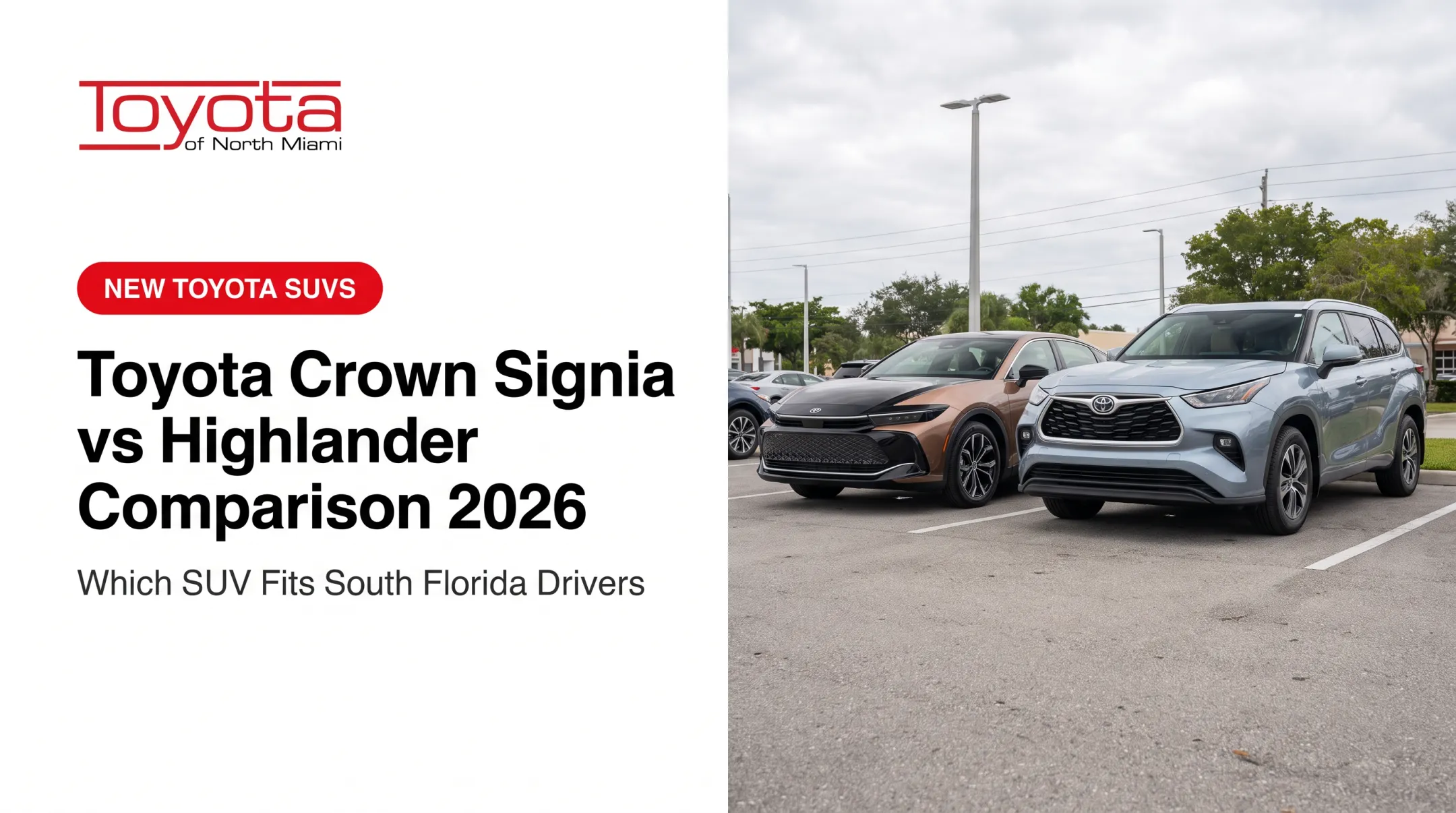
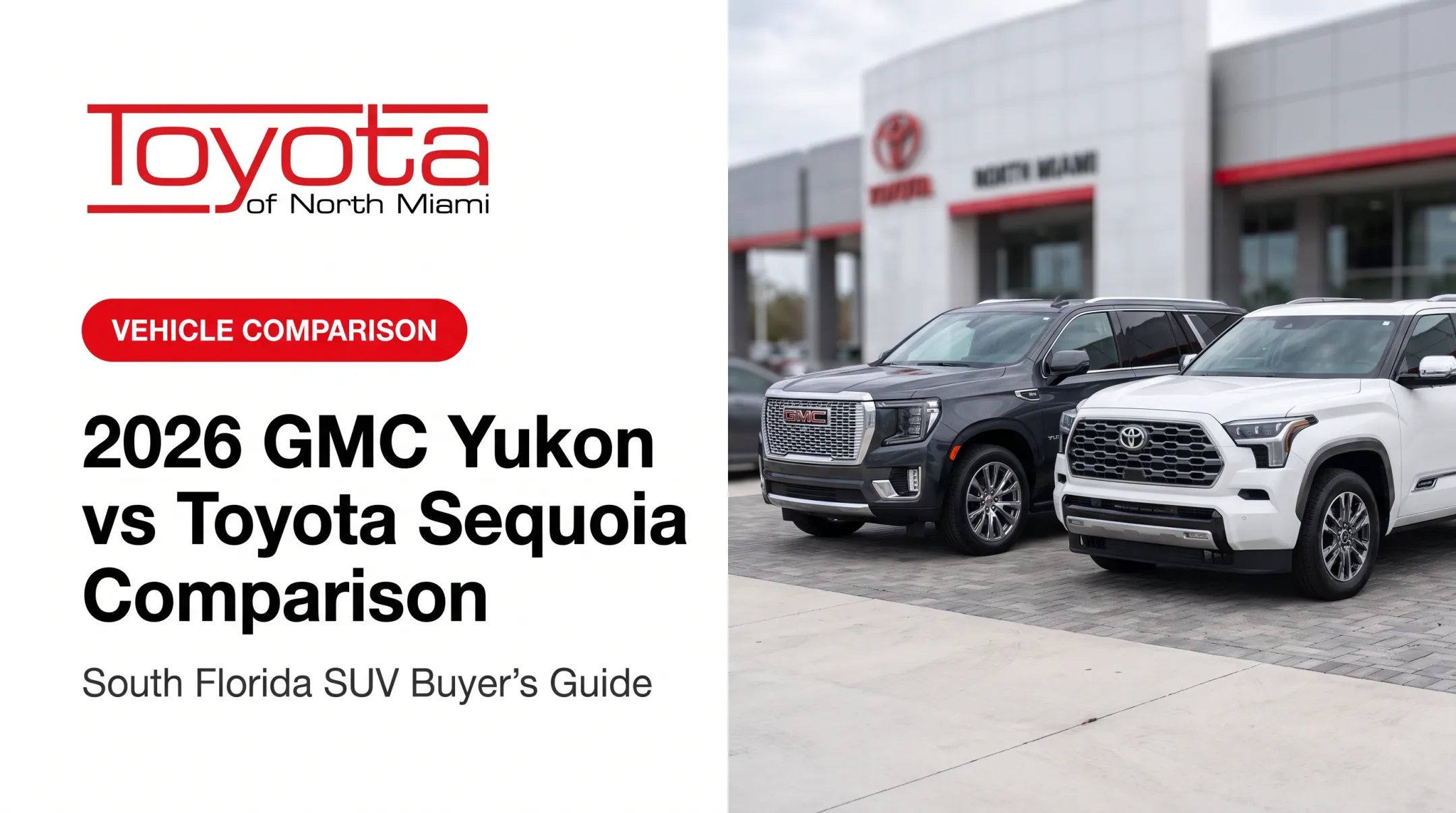
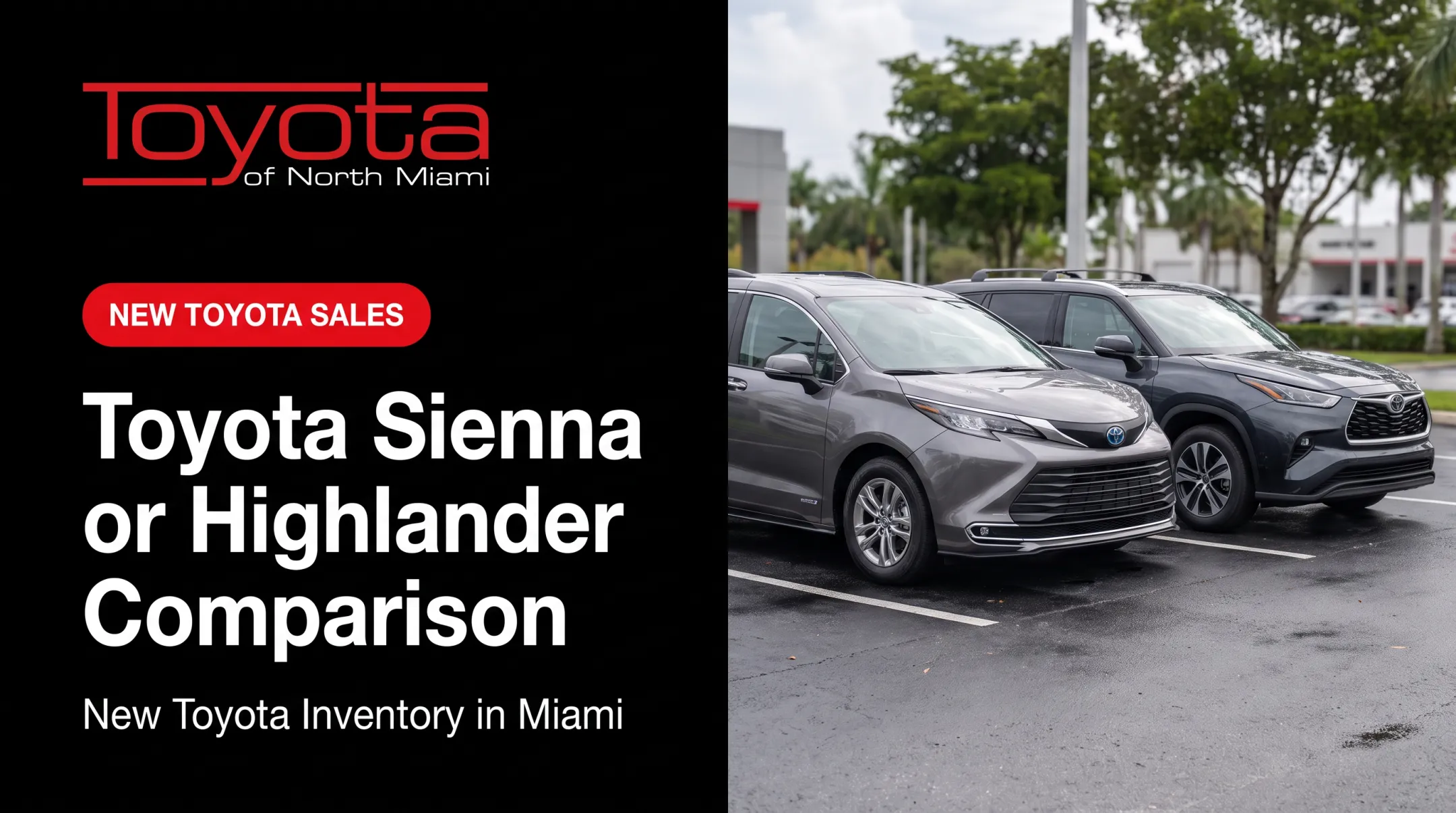
The Sequoia is a full-size, truck-based SUV. The Highlander is a midsize crossover. That distinction affects everything from your monthly fuel bill to how easily you'll parallel park outside a Miami restaurant.
Many families struggle to weigh towing muscle against daily drivability without clear numbers. Below, we break down powertrains, dimensions, cargo space, towing, fuel economy, and safety tech using current 2026 Toyota specifications, so you can match the right SUV to your actual driving habits.
Key Takeaways
- Choose the Sequoia if you tow heavy trailers, need available 4WD, or want full-size capability.
- Pick the Highlander for everyday family driving, tighter parking, and lower running costs in most configurations.
- Specs vary by trim and drivetrain, so always confirm details before signing paperwork.
- Your passenger count, towing needs, and driving environment should drive the final decision.
2026 Toyota Sequoia vs Highlander: Quick Comparison
Here's how the two SUVs stack up on paper, using Toyota's published 2026 figures.
| Specification | 2026 Sequoia | 2026 Highlander Gas | 2026 Highlander Hybrid |
|---|---|---|---|
| Starting MSRP | $65,725 (SR5) | $46,270 (XLE) | $48,020 (XLE) |
| Engine | 3.445L twin-turbo V6 hybrid | 2.4L turbo 4-cylinder | 2.5L 4-cylinder hybrid |
| Horsepower | 437 hp | 265 hp | 243 net hp |
| Torque | 583 lb-ft | 310 lb-ft | Not published by Toyota |
| Drivetrain | RWD or part-time 4WD | AWD standard | Electronic On-Demand AWD |
| EPA combined mpg | 20-22 | 24 | 35 |
| Max towing | 9,500 lbs | 5,000 lbs | 3,500 lbs |
| Seating | 7 or 8 | 7 or 8 | 7 or 8 |

Overall Size and Construction
The Sequoia rides on a fully boxed, high-strength steel ladder frame, with an ultra-high-strength steel cabin and an aluminum hood and doors, according to Toyota's Sequoia brochure. That's body-on-frame construction, the same basic approach used in pickup trucks.
The Highlander uses unibody crossover architecture instead. Unibody designs typically deliver a smoother ride and easier handling in tight spaces, though they trade some of the heavy-duty durability that a ladder frame provides.
Powertrains and Performance
- Sequoia: Hybrid-only, i-FORCE MAX 3.445L twin-turbo V6, 437 hp and 583 lb-ft, paired with a 10-speed automatic transmission
- Highlander gas: 2.4L turbo four-cylinder, 265 hp and 310 lb-ft, 8-speed automatic
- Highlander Hybrid: 2.5L four-cylinder plus electric motor-generators, 243 net combined hp
The Sequoia prioritizes raw output. The Highlander, especially in Hybrid form, leans toward smooth, efficient everyday driving.
Towing and Capability
The Sequoia tops out at 9,500 lbs of towing capacity, backed by a standard Class-IV hitch receiver, integrated trailer brake controller, and Trailer-Sway Control. The gas Highlander manages 5,000 lbs, while the Hybrid Highlander caps at 3,500 lbs, per Toyota's Highlander release.
These are maximums under ideal conditions. Actual capacity shifts with trim, passenger load, and added cargo. Never exceed your specific vehicle's published rating.
Fuel Economy and Ownership Costs
According to EPA's fuel economy data, the Highlander Hybrid earns 35 mpg combined, the gas Highlander earns 24 mpg combined, and the Sequoia ranges from 20 to 22 mpg combined depending on drivetrain.
Beyond the pump, larger vehicles generally mean higher insurance premiums, pricier tires, and steeper maintenance costs. The Sequoia's size and towing hardware add to that equation.
Passenger and Cargo Space
The Sequoia offers 86.9 cubic feet behind the front row and a sliding third row with 22.3 to 11.5 cubic feet of space depending on position. The Highlander maxes out at 84.3 cubic feet with both rear rows folded flat.
Third-row access differs too — the Sequoia's power-folding seats slide forward for easier entry, while the Highlander relies on a simpler fold-flat mechanism.
What Are the 2026 Toyota Sequoia and Highlander Designed to Do?
2026 Toyota Sequoia: Full-Size Strength for Towing and Adventure
The Sequoia exists for buyers who need serious capability. Its body-on-frame construction and part-time 4WD system (branded 4WDemand) support heavier loads and rougher terrain than a typical crossover. The setup includes an electronically controlled 2-speed transfer case and an Automatic Limited-Slip Differential.
This SUV makes sense for:
- Families towing boats, campers, or larger trailers
- Owners hauling bulky outdoor or work equipment regularly
- Drivers who need low-range gearing for unpaved or demanding roads
The trade-offs are real, though. A bigger footprint means tighter parking, a wider turning radius, and generally higher fuel costs than a midsize crossover.
Trim lineup runs SR5, Limited, Platinum, 1794 Edition, TRD Pro, and Capstone. The TRD Pro adds 2.5-inch FOX internal bypass coil-overs, Multi-Terrain Select, and Crawl Control for off-road driving. Higher trims like Capstone bring a 14-inch touchscreen, 14 JBL speakers, and a panoramic roof. Those upgrades are not standard across the lineup.

2026 Toyota Highlander: Crossover Practicality for Everyday Family Driving
The Highlander is built for the daily grind: school runs, commuting, and weekend errands. Its unibody platform makes it noticeably easier to park and maneuver than the Sequoia.
Standard all-wheel drive comes on every 2026 Highlander grade. Gas trims (XLE, XSE, Limited, Platinum) use either mechanical AWD or Dynamic Torque Vectoring AWD, while Hybrid trims (XLE, Limited, Platinum) use Electronic On-Demand AWD.
This crossover fits buyers who:
- Carry passengers regularly but rarely tow more than a light trailer
- Want better fuel economy without sacrificing three-row seating
- Prefer a smaller, easier-to-handle vehicle for daily errands
Third-row comfort is where the Highlander shows its limits. Edmunds' February 2026 road test of the 2026 Toyota Highlander found the third row narrow with thin padding, workable for kids but less so for adults on longer trips.
One important distinction: don't confuse the standard Highlander with the Grand Highlander. The Grand Highlander is a separate, larger model with up to 97.5 cubic feet of cargo space — nearly 13 cubic feet more than the standard Highlander offers.
2026 Toyota Sequoia vs Highlander: Which Is Better for You?
Neither SUV is "better" in an absolute sense. They're built for different jobs.
Choose the Sequoia if you:
- Tow near or above the Highlander's 5,000-lb limit
- Want a commanding driving position and truck-like durability
- Plan frequent off-road or heavy-duty use
- Need maximum cargo flexibility with a sliding third row
Choose the Highlander if you:
- Value easier daily parking and a more car-like ride
- Tow occasionally, but not near the Sequoia's 9,500-lb ceiling
- Want better fuel economy, especially with the Hybrid's 35 mpg combined rating
- Carry passengers more often than bulky gear
Third-row and cargo priorities matter here too. Families hauling strollers, sports gear, and groceries alongside passengers may find the Sequoia's adjustable cargo shelf more useful. Those who just need occasional extra seats will likely find the Highlander sufficient.
Financially, look past the sticker price. A Sequoia Platinum starting near $81,735 carries higher fuel, insurance, and tire costs than a Highlander XLE starting around $46,270. Factor in financing terms, expected mileage, and maintenance schedules before deciding.
Quick decision checklist:
- How many passengers do you carry weekly?
- What's your typical trailer weight?
- City streets or open highways — which do you drive more?
- Is fuel economy or towing capacity your higher priority?
- Do you need off-road-capable hardware, or just reliable AWD?
Real-World Buying Considerations
Picture a family of five in South Florida: daily school drop-offs, weekend trips to the Keys, and the occasional boat tow for fishing. If towing happens a few times a year, the Highlander likely covers it while saving money on fuel every week. If that boat comes out every weekend, the Sequoia's 9,500-lb capacity removes any doubt.
Ride quality is another daily factor. Edmunds' 2026 Highlander test noted a plush ride over rough pavement with controlled body roll, a point worth weighing against the Sequoia's stiffer, truck-like ride.
Before you commit, take these steps:
- Compare exact trims: a Highlander XLE and a Highlander Platinum differ significantly in equipment.
- Confirm current pricing and incentives, since figures shift throughout the model year.
- Evaluate your trade-in value and financing options side by side.
- Schedule back-to-back test drives to feel the size difference firsthand.

If you're weighing a Sequoia against a Highlander, Toyota of North Miami can walk you through current inventory, financing options, and trade-in values for both. Stop by to compare them in person and schedule a test drive before making your final call.
Conclusion
The 2026 Sequoia is Toyota's capability-focused full-size SUV, built for towing, off-road use, and families who need maximum hauling power. The Highlander remains the more compact, everyday-friendly choice, offering easier parking, better fuel economy, and plenty of room for typical family life.
Your decision should come down to how often you tow, how many passengers you carry, and where you spend most of your driving time. Specifications, pricing, and available features change by trim and model year, so confirm final 2026 details, incentives, and availability before you sign anything.
Frequently Asked Questions
Which is better, the Toyota Sequoia or the Toyota Highlander?
The Sequoia is generally better for heavy towing and full-size capability, while the Highlander suits everyday family driving and easier maneuvering. Trim and drivetrain choice can shift this comparison.
Is the Toyota Sequoia bigger than the Grand Highlander?
The Sequoia and Grand Highlander serve different purposes — the Sequoia is a full-size, body-on-frame SUV, while the Grand Highlander is a larger unibody crossover than the standard Highlander. Confirm exact dimensions and cargo figures with Toyota before comparing.
What is the main difference between the Toyota Sequoia and Highlander?
The Sequoia is a truck-based, full-size SUV built for towing and capability. The Highlander is a midsize crossover designed around everyday family comfort and efficiency.
Which Toyota SUV has more towing capacity, the Sequoia or Highlander?
The Sequoia tows up to 9,500 lbs, compared to 5,000 lbs for the gas Highlander and 3,500 lbs for the Highlander Hybrid. Actual capacity depends on trim, drivetrain, and equipment.
Which is more fuel-efficient, the Toyota Sequoia or Highlander?
The Highlander Hybrid leads at 35 mpg combined, followed by the gas Highlander at 24 mpg combined. The Sequoia ranges from 20 to 22 mpg combined depending on drivetrain.
Does the Toyota Sequoia or Highlander have more third-row space?
The Sequoia's sliding third row offers more flexibility and legroom range than the Highlander's fixed fold-flat seats. Still, sit in both with your usual passengers before deciding — comfort is personal.