Sticker price alone won't tell you which truck fits your budget. Trim level, drivetrain, hybrid availability, destination fees, taxes, dealer charges, and financing terms all shift the real number you'll pay. A base Tacoma SR and a loaded Tundra Capstone might as well be different vehicles.
This guide compares current Tacoma and Tundra pricing, capability, and real-world use cases, so you know where each truck earns its price tag. Specs and figures change often, so verify current pricing and configurations before you buy.
Key Takeaways
- Tacoma's entry price undercuts Tundra's by roughly $8,700 at base MSRP, though equipped trims often overlap
- Match trims and drivetrains when comparing, not the cheapest Tacoma against a loaded Tundra
- Tacoma suits daily driving, light-to-moderate towing, and tight off-road trails; Tundra justifies its premium for heavy towing and passenger space
- Used pricing doesn't track new-vehicle pricing; mileage, condition, and demand move the number more than model name
- Always compare the full out-the-door price, not just the advertised figure
Toyota Tacoma vs Tundra: Quick Comparison
Starting Price
The 2026 Tacoma starts at $32,545 MSRP. The 2026 Tundra starts at $41,260. That's roughly an $8,700 gap before you add a single option.
Neither figure includes destination charges, taxes, registration, or dealer fees. Toyota's pricing page lists these as base configuration numbers only. Expect your out-the-door price to run higher on both trucks.
At Toyota of North Miami, real listings show how this plays out locally. A 2026 Tacoma SR5 RWD Double Cab has carried a Total SRP of $40,617, discounted to a Cyber Price near $38,909. A 2026 Tundra SR RWD CrewMax has listed around $47,675 SRP, already well above any Tacoma trim.

Comparable Trim Pricing
Compare equivalent trims, not just the cheapest option on each truck:
| Grade | Tacoma starting MSRP | Tundra starting MSRP |
|---|---|---|
| Entry (SR) | $32,545 | $41,260 |
| Mid (SR5) | $36,635 | $46,510 |
| Off-road/TRD | $39,135–$42,815 | N/A at this tier |
| Limited | $53,570 | $54,860 |
| Top trim (Pro/Capstone) | $64,750 | $80,800 |
Notice where the lines blur. A well-equipped Tacoma Limited lands close to an entry Tundra Limited. That overlap is exactly why a simple price ranking misses the point: equipment, cab size, and capability differ even when the sticker price doesn't.
Powertrain and Hybrid Pricing
Both trucks offer the i-FORCE MAX hybrid powertrain. On matched Tacoma configurations, the hybrid upgrade runs about $3,720 over gas. On Tundra, the same upgrade costs roughly $3,700 to $3,925, depending on trim.
What you get for that premium:
- Tacoma hybrid: 326 horsepower, 465 lb-ft of torque, better low-end response
- Tundra hybrid: 437 combined horsepower, 583 lb-ft of torque, stronger towing margin
The hybrid isn't automatically the smarter buy. If you rarely tow near the limit, the gas engine often makes more financial sense.
Capability Relative to Price
Official maximums reach 6,500 pounds towing and 1,705 pounds payload on Tacoma, and up to 12,000 pounds towing on properly equipped Tundra configurations, according to Toyota's newsroom release.
Real-world Tundra listings at Toyota of North Miami show towing figures in the 8,300-pound range on certain trims. Advertised maximums depend heavily on cab, bed, and drivetrain.
The smarter approach: match capability to actual need.
- Towing a small camper or boat under 6,000 pounds? Tacoma likely covers it.
- Hauling a large travel trailer or equipment trailer regularly? You need Tundra-level capacity.
- Don't pay for 12,000 pounds of towing you'll never use.
Ownership-Cost Considerations
Fuel economy favors Tacoma across most configurations: combined ratings run 21-23 mpg versus Tundra's 19-20 mpg on comparable drivetrains. Both trucks carry the same included maintenance window: 2 years or 25,000 miles.
- Tacoma's smaller tires (17-18 inch depending on trim) typically cost less to replace than Tundra's 18-22 inch options
- A lower purchase price can get erased by financing interest or fuel costs over a long loan term
- A higher Tundra price can pay for itself if it keeps you from maxing out a smaller truck's limits
Price-Checking Guidance
Before signing anything, request an itemized buyer's order showing:
- MSRP and destination charge
- Dealer-added accessories or packages
- Discounts and incentives applied
- Taxes, registration, and dealer documentation fees
Inventory and incentives shift monthly. Toyota of North Miami's listings, for example, exclude tax, tag, and a documentation fee from advertised prices. Those details are worth confirming before you commit to a configuration.
What Is the Toyota Tacoma and What Is the Toyota Tundra?
Toyota Tacoma: Price Profile and Best-Fit Buyers
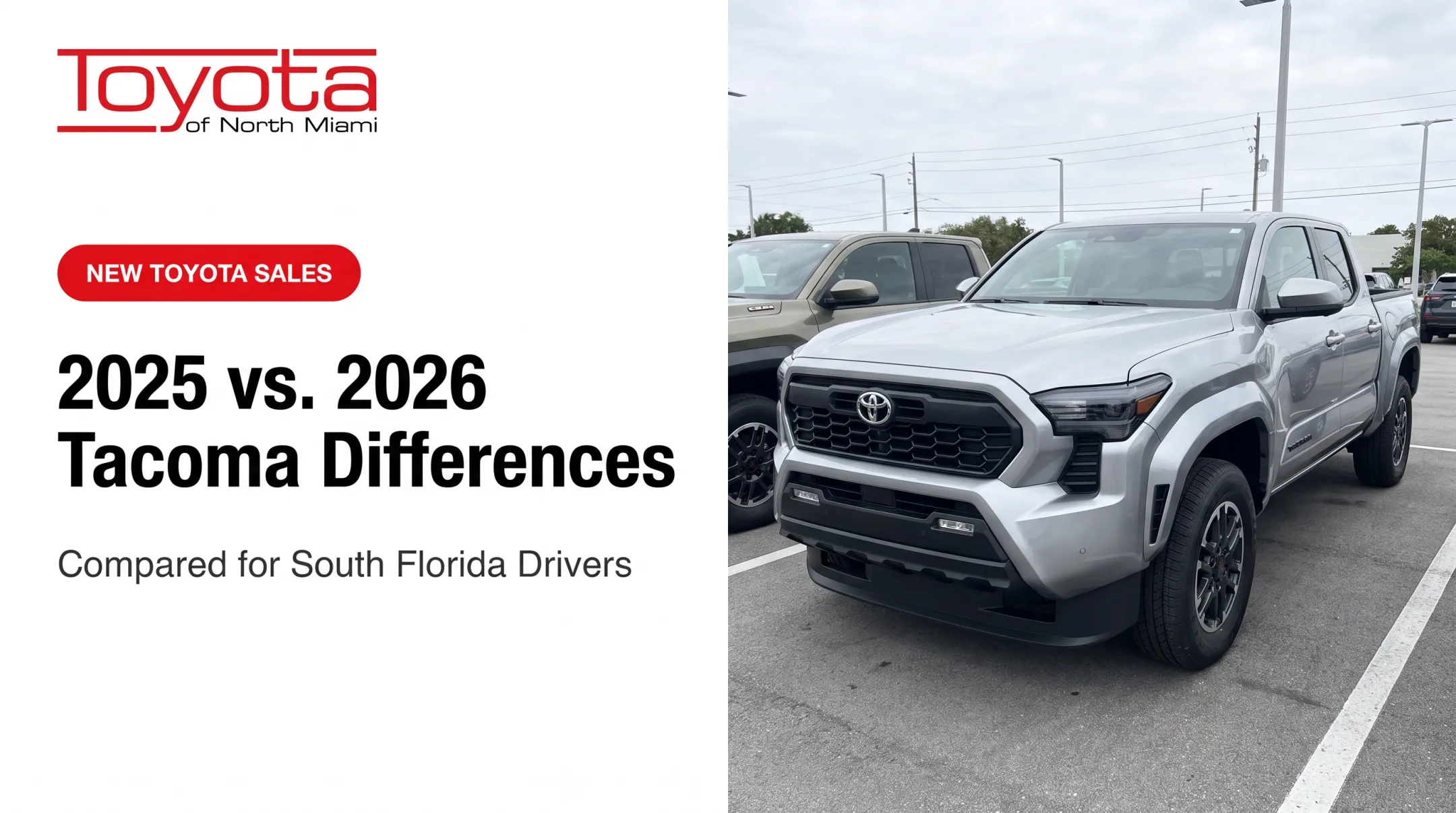
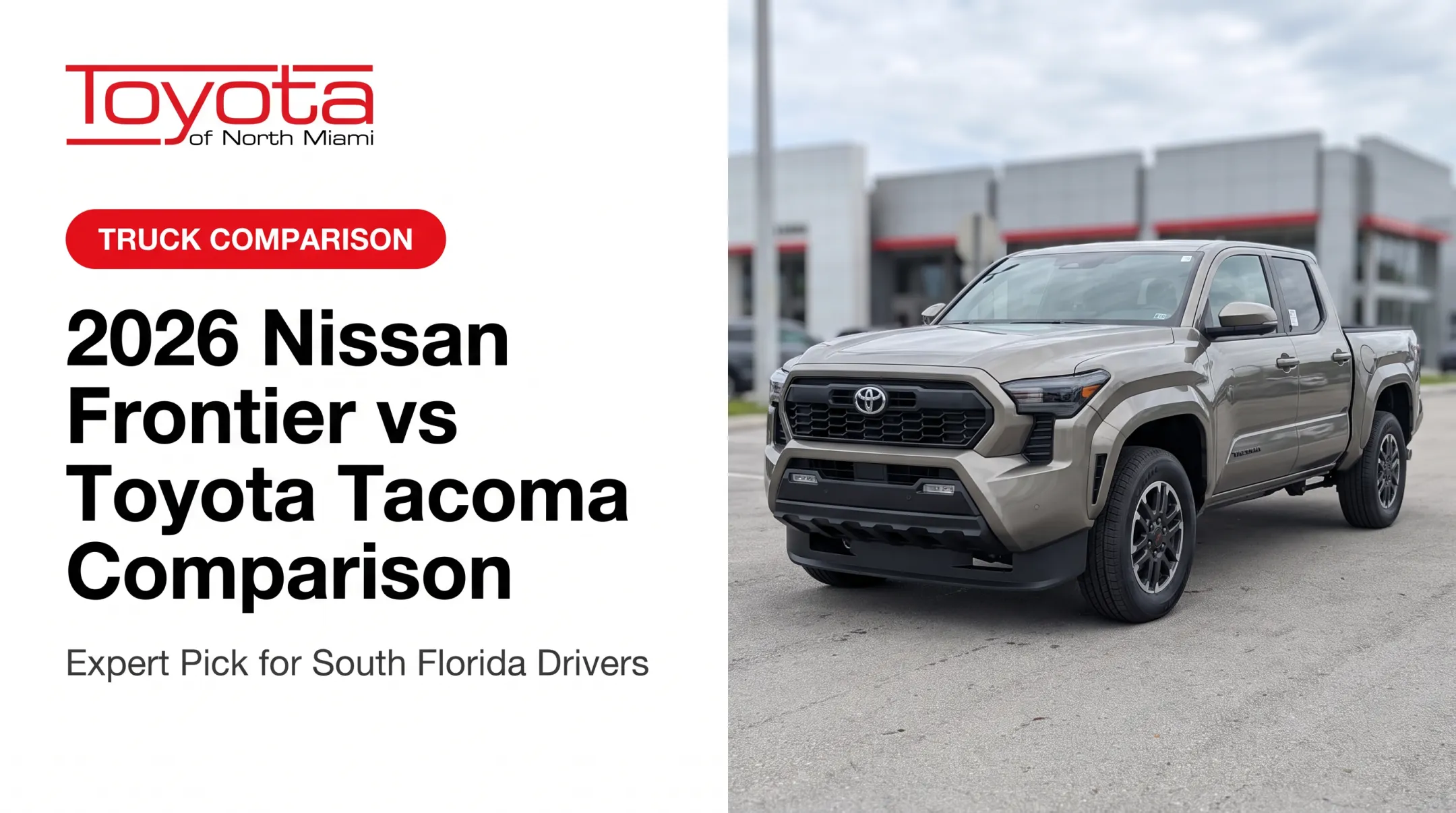
The Tacoma is Toyota's midsize pickup. Its smaller footprint translates into a lower entry price, easier parking, and less space needed in your driveway or garage.
Current trims run from SR through SR5, TRD PreRunner, TRD Sport, TRD Off-Road, and Limited. Cab and bed choices stay compact: Double Cab or XtraCab, with 5-foot or 6-foot beds.
Pricing climbs quickly once you start adding:
- Four-wheel drive
- TRD off-road hardware and all-terrain tires
- Premium trim equipment like JBL audio and a head-up display
- The i-FORCE MAX hybrid powertrain
An SR5 4WD Double Cab at Toyota of North Miami, for instance, listed near $43,588 after discount, a jump from the base SR's starting point. Still, the Tacoma's lower overall ceiling and strong fuel economy make it the easier truck to budget around for commuting, light work, and weekend camping trips.
Where it falls short: frequent heavy trailering, large crews needing full-size rear seating, or buyers who regularly haul substantial payloads. That's Tundra territory.
Toyota Tundra: Price Profile and Best-Fit Buyers
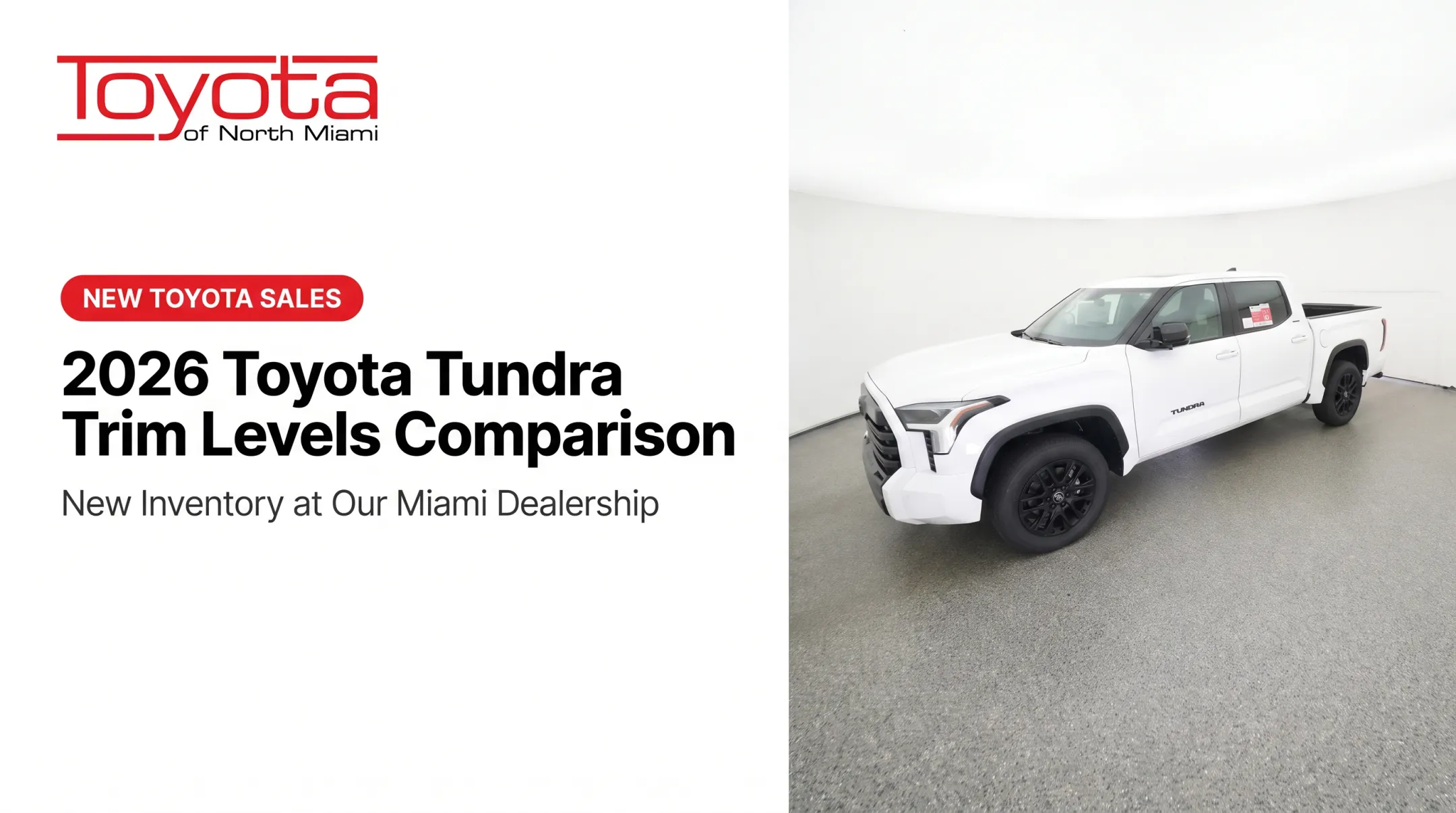
The Tundra is Toyota's full-size pickup. Its larger frame, roomier cabin, and higher-output engines explain the higher starting price across every trim.
Current grades span SR, SR5, Limited, Platinum, 1794 Edition, Capstone, and TRD Pro, most available with either the 3.4L twin-turbo V6 gas engine or the i-FORCE MAX hybrid. CrewMax configurations dominate Toyota of North Miami's current inventory, offering the rear-seat space a Tacoma simply can't match.
The value case for Tundra shows up when:
- You tow near or above 8,000 pounds regularly
- Three adults need real rear legroom, not a jump seat
- You need bed length and payload beyond what a midsize truck offers
Choosing Tundra can be the financially smarter move if it eliminates the need for aftermarket upgrades or keeps you from running a smaller truck past its rated limits. It's harder to justify if your driving stays mostly urban, your hauling is occasional, or your main priority is the lowest possible monthly payment.

Toyota Tacoma vs Tundra: What Is Better for Your Budget?
Start with how you'll actually use the truck, not the specs sheet. Ask yourself:
- How often will I tow, and how heavy is the loaded trailer?
- How many passengers ride regularly?
- What has to fit in the bed?
- Do I need serious off-road capability?
Choose Tacoma if you want the lowest entry price, easier maneuverability, and your towing and payload needs stay moderate. Choose Tundra if you tow or haul heavier loads often, need a full back seat for adults, or plan to keep the truck long enough that the extra capability pays off.
A Smarter Way to Compare Payments
Don't compare an advertised Tacoma payment against an advertised Tundra payment. They rarely use matching assumptions. Instead:
- Use the same down payment percentage for both trucks
- Apply the same loan term and interest rate
- Include identical trade-in value and tax treatment
- Compare the resulting monthly figures side by side
Decision Checklist
Before deciding, weigh:
- Purchase price and out-the-door total
- Financing terms and expected interest cost
- Fuel and insurance differences
- Routine maintenance and tire replacement
- Resale expectations
- Cost of upgrading later if you undersize the truck
Toyota of North Miami's inventory includes both new Tacoma and Tundra configurations, along with trade-in appraisal and financing tools to help compare real numbers rather than advertised ones. Requesting an itemized quote on each truck you're considering remains the most reliable way to see where your money actually goes.
Real-World Price Scenarios
Scenario 1: The weekend hauler. A buyer commutes daily, hauls dirt bikes on weekends, and occasionally tows a small trailer under 5,000 pounds. A Tacoma SR5 4WD, priced in the low $40,000s, covers this use case without the higher fuel costs or parking footprint of a Tundra.
Scenario 2: The heavy tower. A buyer regularly tows a 9,000-pound travel trailer and drives with three kids most weekends. Here, a Tundra SR5 or Limited CrewMax, despite starting tens of thousands higher, avoids the risk of exceeding a Tacoma's rated limits and gives the family real rear-seat room.
Scenario 3: The used-market surprise. Used pricing doesn't always follow new-vehicle logic. A 2024 Tundra SR5 4x4 with roughly 48,000 miles has listed around $43,357, not far off a 2025 Tacoma TRD Sport 4x4 with far fewer miles at $41,495.

Mileage, condition, and demand move used prices more than badge size. KBB's resale report forecasts Tacoma retaining more value than Tundra over five years, a projection rather than a guaranteed discount on any single used truck.
Check Toyota Certified Used Vehicle status, accident history, and configuration before assuming either truck is the better deal. Toyota of North Miami's new, used, and certified pre-owned inventory is worth a side-by-side look before you commit.
Conclusion
The Tacoma remains the more accessible choice for buyers who want a lower purchase price, easier parking, and enough capability for daily driving and recreation. The Tundra earns its higher price with full-size space and heavier-duty performance for buyers who need it regularly.
There's no universal winner here. Pick the least expensive truck that safely and comfortably handles your real towing, payload, and passenger needs. Then verify current pricing and financing terms at Toyota of North Miami before you sign.
Frequently Asked Questions
Is the Toyota Tundra more expensive than the Toyota Tacoma?
Yes, Tundra's base MSRP starts roughly $8,700 higher than Tacoma's. That gap can widen or narrow depending on trim, drivetrain, hybrid equipment, and current incentives, so always compare matched configurations.
Why are used Toyota Tundras cheaper than Toyota Tacomas?
They're not always cheaper - it depends on mileage, condition, model year, and local demand. Depreciation and fuel costs can push some used Tundra prices below comparable Tacomas, but not universally.
Which is better: Toyota Tacoma or Toyota Tundra?
Neither is universally better. Tacoma fits lower-cost, maneuverable daily use and moderate towing; Tundra fits heavier towing, hauling, and passenger-space needs.
What are the main differences between the Toyota Tacoma and the Toyota Tundra?
Tacoma is a midsize truck with a lower price, smaller footprint, and moderate towing capacity. Tundra is full-size, with a higher price, roomier cabin, and significantly higher towing and payload ceilings.
Which lasts longer, Toyota Tacoma or Toyota Tundra?
Longevity depends more on maintenance history and driving conditions than model choice. Consumer Reports currently predicts above-average reliability for Tacoma and average reliability for Tundra, based on recent model-year data.
How much bigger is the Toyota Tundra than the Toyota Tacoma?
A Tundra CrewMax runs about 20 inches longer and several inches wider than a comparable Tacoma Double Cab, with notably more rear shoulder and hip room. Exact differences vary by cab, bed, and trim.