The truth is, there's no single mileage marker, model year, or calendar month that works for every driver. The right time depends on your vehicle's condition, your loan payoff, and what replacing it would actually cost.
This guide walks through how depreciation and equity affect your timing, what scenarios tend to push the decision one way or another, and when holding onto your current car is the smarter financial move. We'll also cover a quick preparation checklist before you ever set foot on a lot.
Key Takeaways
- No universal age, mileage, or month guarantees the best trade-in value for every vehicle.
- Trade before a major repair or mileage milestone; maintenance history outweighs the odometer alone.
- Check your current market value and loan payoff first, especially if negative equity is a possibility.
- Compare total ownership costs of keeping versus replacing your vehicle, not just the monthly payment.
Why Timing Matters for Trading In Your Car
Every vehicle loses value the moment it leaves the lot, and that decline doesn't happen at a steady pace. According to KBB's depreciation guide, many vehicles lose about 20% or more of their value in the first year alone, with new cars often shedding roughly 55% within five years. The steepest drop happens early, which is why timing a trade-in isn't just about mileage.

A well-maintained car with warranty coverage remaining is simply easier for a dealer to recondition and resell. That translates to stronger offers compared to a vehicle needing repairs before it can go back on the lot.
Understanding Your Equity Position
Before anything else, you need to know where you stand financially:
- Positive equity: your car's value exceeds what you owe, reducing the amount you'll finance next.
- Break-even equity: value and payoff are roughly equal.
- Negative equity: you owe more than the car is worth, meaning that gap often gets rolled into your new loan.
This isn't a small issue. Negative equity trade-ins carry serious weight nationally, averaging $6,884 in Q2 2026 according to Edmunds' industry report.
Total Cost, Not Just Payment
A low monthly payment can mask a bad deal. Compare the complete cost of keeping your current car against the complete cost of a replacement, including:
- Repairs and maintenance
- Fuel and insurance
- Financing charges and loan term
- Taxes, registration, and fees
Beyond the math, non-financial reasons matter too. Declining reliability, outdated safety tech, a longer commute, or a new need for towing capacity can all shift the calculation even when the numbers alone wouldn't.
Best Time to Trade In Your Car Based on Different Scenarios
The best time to trade in isn't a date on a calendar. It's a set of circumstances specific to your vehicle and your budget.
Based on Mileage, Age, and Depreciation
There's no magic mileage cutoff. A 3-year-old car with 50,000 mostly highway miles can be in better condition than a same-age vehicle with only 36,000 hard city miles, according to KBB's keep-or-trade guide. What actually matters:
- Annual mileage relative to typical use
- Service history and documentation
- Highway versus stop-and-go driving
- Vehicle type and expected upcoming maintenance
Check your car's current value before and after major mileage or age milestones instead of waiting for a fixed number.
Based on Condition, Repairs, and Warranty
Certain signs suggest it's worth running the numbers on a trade-in:
- Recurring warning lights
- Transmission or engine concerns
- Repeated major repairs
- Rust or structural damage
- A repair estimate that changes your cost calculation
Trading before an expensive scheduled repair, or shortly after warranty coverage lapses, can make sense. But don't replace a dependable car just because a warranty milestone is approaching. Toyota of North Miami's Sell Us Your Car program specifically flags costly repairs and expired warranty coverage as practical reasons to consider a trade, not reasons to panic.
Based on Equity and Loan Timing
Get an up-to-date payoff quote from your lender and compare it against several value estimates before visiting any dealership. Then:
- Calculate your equity position using the payoff and current value.
- If positive, that equity reduces what you'll finance next.
- If negative, consider waiting, making extra principal payments, choosing a cheaper replacement, or bringing cash to cover the gap.
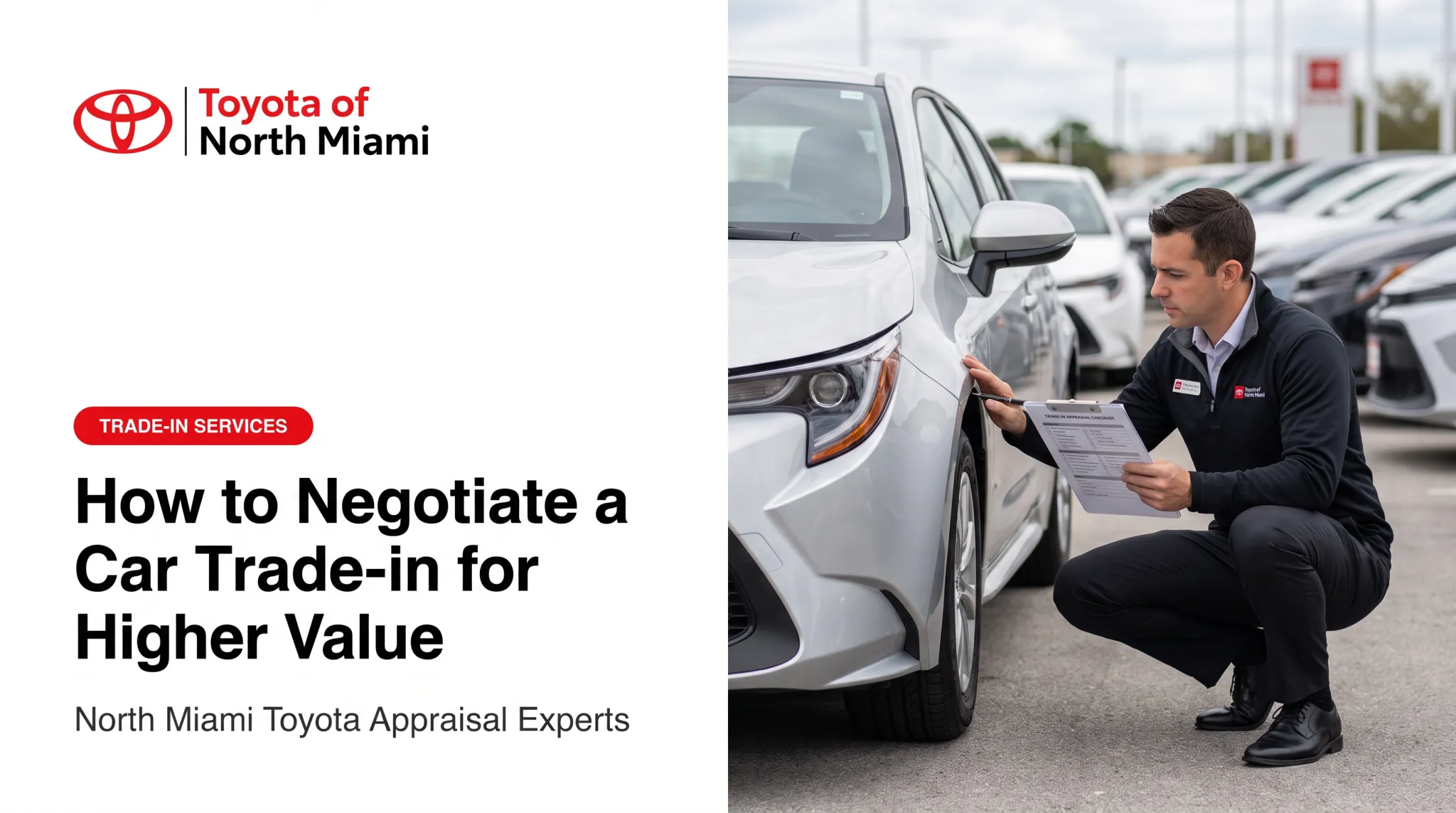
Toyota of North Miami's Trade-In Appraisal tool walks through condition ratings for body, engine, tires, and interior, then produces an estimate with a stated 20–30-minute in-person turnaround.

Based on Seasonality and Market Conditions
Demand shifts by vehicle type, region, and inventory levels. Cox Automotive's research documents a typical early-summer slowdown in used-retail demand. Edmunds' buying guide notes December has historically carried the strongest new-car discounts as dealers clear outgoing model years.
Here's the catch: a good month for your trade-in value isn't necessarily the best month for your replacement's price. Compare both sides of the transaction at the same time, not just one.
Based on Lifestyle or Ownership Changes
Sometimes the car itself is fine, but your life changed around it. A trade-in may make sense when your current vehicle no longer fits:
- Family size or cargo needs
- A new, longer commute
- Towing requirements
- Accessibility needs
- A shift toward hybrid or electrified driving
A new towing need, for example, is one reason shoppers consider the 2026 Toyota 4Runner i-FORCE MAX, which includes an integrated towing receiver hitch.
If you're near lease-end, review mileage charges, purchase options, and payoff figures before you decide.
When You Should Avoid Trading In and What Happens If Timing Is Wrong
Replacing a car isn't automatically a financial upgrade. If your current vehicle is reliable, cheap to maintain, and nearly paid off, trading it in can set you back.
Waiting often makes more sense when:
- You have substantial negative equity
- A recent repair restored reliability
- Ongoing ownership costs are already low
- Maintenance records are incomplete, which could hurt your offer
- A replacement would mean an unaffordable payment or an excessive loan term
The Negative Equity Trap
Trading in with negative equity doesn't erase the debt. It rolls the shortfall into your next loan, so you start the new loan underwater with higher finance charges. In some cases, you end up owing more than the replacement vehicle is worth before you've even driven it home.

Don't let a lower monthly payment drive the decision on its own. A longer loan term can shrink the payment while raising total cost through:
- More interest paid over time
- Warranty coverage that ends before the loan does
- Higher fees baked into a longer term
Risks of Waiting Too Long
The flip side carries risk too. The longer you wait:
- Depreciation and mileage keep accumulating
- Warranty protection can expire mid-ownership
- A major mechanical failure becomes more likely
- Accident or wear damage can lower your appraisal
Owning a vehicle has real costs regardless of which direction you choose. AAA's 2026 driving cost study pegs the average annual cost of owning a new vehicle at $12,863, covering depreciation, financing, insurance, fuel, and maintenance combined.
Weigh that figure against what you're currently spending to keep your existing car running before assuming a swap saves money.
Best Practices for Timing a Trade-In Correctly
Once you've decided the timing makes sense, preparation protects your offer. Run through this checklist:
- Research several current value estimates from different sources, not just one.
- Gather service records and title information to document condition and ownership history.
- Get your loan payoff quote so you know your exact equity position.
- Inspect for safety or mechanical issues honestly, without masking anything.
- Remove personal items and clean the vehicle — skip unnecessary cosmetic repairs that won't move the needle.
Then separate every piece of the transaction instead of lumping them together:
- Trade-in offer
- Replacement vehicle price
- Financing terms and interest rate
- Incentives, taxes, and fees
- Total amount financed
Shoppers can handle much of this remotely. Toyota of North Miami's online tools — including the Trade-In Evaluator, Payment Calculator, and secure credit application — let you line up numbers before requesting a formal appraisal. These tools don't guarantee a specific offer or approval outcome, but they do save time once you're ready to visit in person.
Conclusion
The best time to trade in a car is when value, condition, equity position, and reliability make replacement more practical than continued ownership. A birthday or odometer reading alone is not the signal.
Start by checking your current value and loan payoff, then compare the real numbers side by side. If the math works in your favor, Toyota of North Miami's trade-in and shopping tools can help you explore new, pre-owned, or Toyota Certified Used Vehicles without committing to anything upfront.
Frequently Asked Questions
When should you trade in your car?
The right time depends on your equity position, vehicle condition, mileage, repair risk, and warranty status. Check whether your replacement fits your budget and needs before deciding, rather than relying on a fixed schedule.
What mileage is best to trade in your car?
There's no universal mileage target. Annual use, maintenance history, vehicle type, current condition, and upcoming scheduled service all affect the right timing more than the odometer number alone.
What is the best month to trade in your car?
Market demand and inventory vary by vehicle type and region, so there's no single best month for everyone. Compare your current trade-in value and replacement pricing together before timing your visit around a specific month.
When should you not trade in your car?
Avoid trading in if you have significant negative equity, low ongoing repair costs, a reliable car, or a loan that's nearly paid off. It's also worth waiting if a replacement would create an unaffordable payment.
Can I trade in my car if I still owe money on it?
Yes, trading in with an outstanding loan is generally possible. Your payoff amount gets compared against the car's current value, and whether you have positive or negative equity changes how your next purchase is financed.