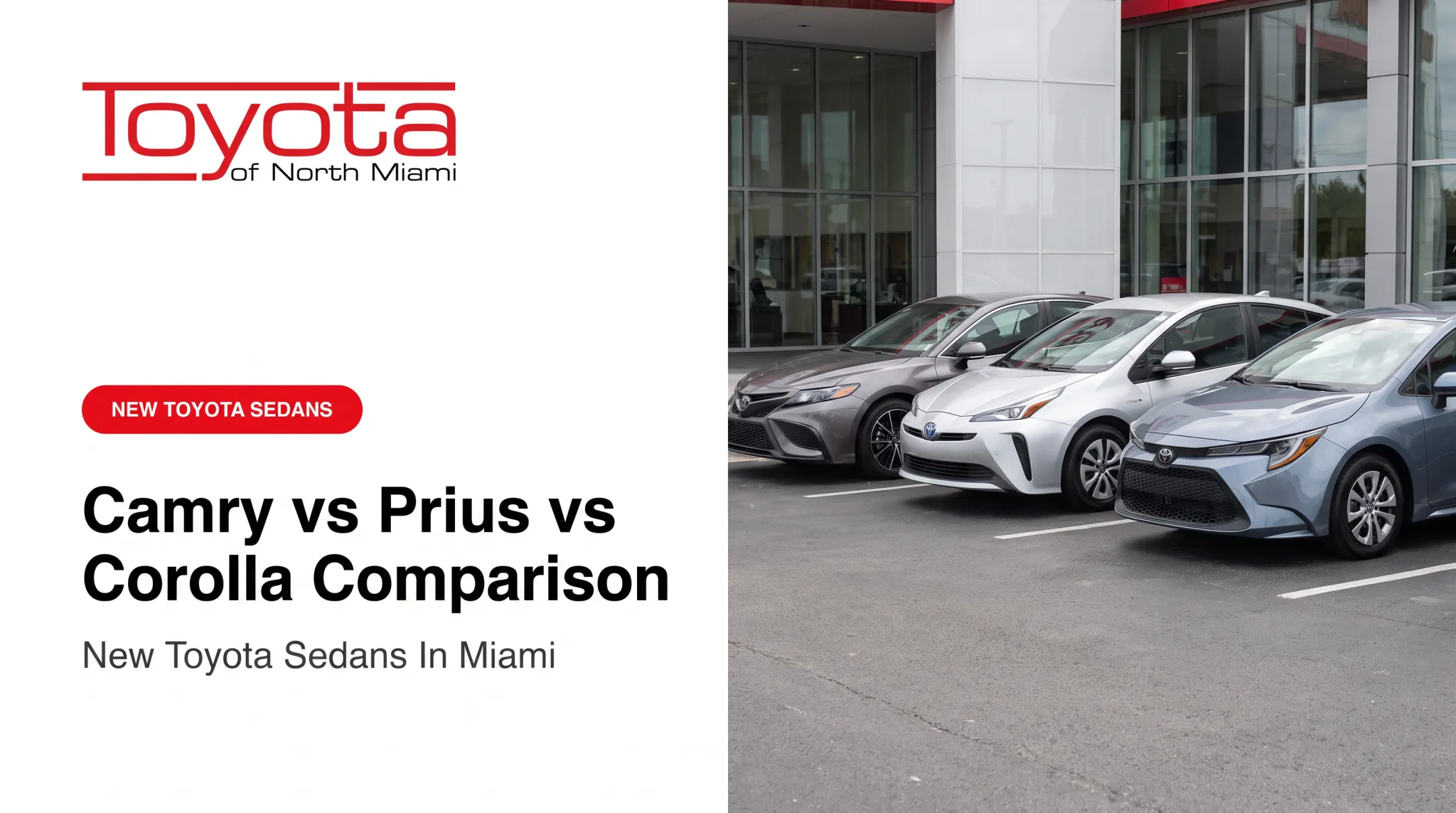
This comparison matters because the gap between these two sedans isn't just about size. It touches purchase price, fuel economy, passenger space, and how each car feels on a daily commute versus a long road trip. Toyota's official 2026 pricing shows a $6,475 gap between the Corolla LE and Camry LE, and the fuel economy numbers don't always break the way you'd expect.
Using verified 2026 Toyota and EPA data, here's how the Corolla and Camry actually stack up for commuting, family duty, parking, and budget.
Key Takeaways
- Camry is Toyota's larger midsize sedan; Corolla is the compact option, about 11 inches shorter overall.
- 2026 Camry is hybrid-only; Corolla still offers both gas and hybrid powertrains.
- Corolla pricing starts near $23,125, well under the Camry Hybrid LE's $29,600 starting MSRP.
- Pick Corolla for tight budgets and urban parking; Camry for rear-seat space and highway comfort.
- Compare both by trim, drivetrain, and intended use, not reputation alone.
Toyota Corolla vs. Camry: Quick Comparison
Price and Overall Value
Toyota's official pricing puts real distance between these two nameplates. The base Corolla LE (gasoline) starts at $23,125, while the Corolla Hybrid LE starts at $24,975. The Camry LE Hybrid, the only powertrain Toyota now offers on the Camry, starts at $29,600.
That's a $6,475 gap between the cheapest Corolla and the cheapest Camry, narrowing to $4,625 if you're comparing hybrid to hybrid.
| Model | Trim/Powertrain | Starting MSRP |
|---|---|---|
| Corolla | LE, gasoline | $23,125 |
| Corolla Hybrid | LE | $24,975 |
| Camry | LE, hybrid | $29,600 |
Real-world listings at Toyota of North Miami typically run a bit higher than MSRP once destination charges and dealer fees are added. Corolla LE sedans in current inventory have shown total sale prices in the $25,000 to $26,000 range, while Camry LE Hybrids have listed closer to $31,800 to $32,800. Pricing shifts with incentives and inventory, so confirm current numbers before you commit to a trim.
Size, Passenger Room, and Cargo Space
The Corolla's compact dimensions are its biggest selling point for city drivers. The Camry's extra length and width translate directly into rear-seat comfort and trunk capacity.
| Measurement | Corolla LE | Camry LE | Difference |
|---|---|---|---|
| Overall length | 182.5 in | 193.5 in | +11.0 in (Camry) |
| Overall width | 70.1 in | 72.4 in | +2.3 in (Camry) |
| Rear legroom | 34.8 in | 38.0 in | +3.2 in (Camry) |
| Trunk capacity | 13.1 cu ft | 15.1 cu ft | +2.0 cu ft (Camry) |
| Turning circle | 35.6 ft | 37.4 ft | Corolla tighter |
Three inches of rear legroom sounds small until you're trying to fit an adult behind a tall front-seat driver. That's where the Camry pulls ahead. The Corolla's tighter turning circle, meanwhile, makes a real difference in cramped garage entrances or parallel parking on narrow streets.
Powertrain, Performance, and Fuel Economy
Here's where the comparison gets interesting: a bigger car doesn't automatically mean worse mileage.
Corolla powertrains:
- Gasoline: 2.0L four-cylinder, 169 hp, Dynamic-Shift CVT, FWD only
- Hybrid: 1.8L four-cylinder hybrid, 138 net combined hp, FWD standard, AWD available on LE/SE
Camry powertrain:
- 2.5L four-cylinder hybrid, every trim and grade
- 225 net combined hp (FWD) or 232 hp (AWD)
| Configuration | City | Highway | Combined |
|---|---|---|---|
| Corolla Gas LE, FWD | 32 | 41 | 35 |
| Corolla Hybrid LE, FWD | 53 | 46 | 50 |
| Camry LE, FWD | 52 | 49 | 51 |
According to EPA's fuel economy data, the Camry LE Hybrid actually edges out the Corolla Hybrid LE in combined mileage, 51 mpg versus 50. You're also getting nearly 90 more horsepower in the Camry. That's a meaningful trade-off if efficiency and highway merging power both matter to you.

Comfort and Everyday Driving
The Corolla shines in tight spaces. Its smaller turning radius and shorter body make it genuinely easier to thread through parking garages, apartment complex lots, and narrow residential streets. For short commutes or solo errands, that maneuverability counts for something every single day.
The Camry trades some of that nimbleness for stability and quiet at speed. Extra wheelbase and a heavier curb weight generally mean a more settled ride on the interstate, plus more shoulder room for passengers on longer trips. Neither car is sporty in the traditional sense, but the Camry feels more composed when you're logging highway miles.
Safety and Ownership Confidence
Both sedans come standard with Toyota Safety Sense 3.0, which on the Corolla includes:
- Pre-Collision System with Pedestrian Detection
- Full-Speed Range Dynamic Radar Cruise Control
- Lane Departure Alert with Steering Assist
- Lane Tracing Assist
- Road Sign Assist
- Automatic High Beams
- Proactive Driving Assist
The Camry carries the same TSS 3.0 suite, plus standard Blind Spot Monitor, Rear Cross-Traffic Alert, and Safe Exit Alert. Higher Camry trims can add a Premium Plus Package with Traffic Jam Assist and a panoramic view monitor.
Warranty coverage is identical across both models: 36 months/36,000 miles basic, 60 months/60,000 miles powertrain, and on hybrids, 10 years/150,000 miles for the battery, according to Toyota's warranty guide. Resale value tends to favor both nameplates, with Kelley Blue Book noting the Camry holds some of the best resale value in its class. Actual reliability and resale always depend on maintenance history, mileage, and how the car was driven, not the badge alone.
What Are the 2026 Corolla and Camry Like?
Toyota Corolla: Compact Efficiency and Maneuverability
The Corolla is Toyota's entry-level sedan, built for shoppers who want a smaller footprint and a lower price of entry. You get a choice between the 169-hp gasoline engine and the more efficient hybrid, which reaches an EPA-estimated 50 mpg combined in FWD trim.
If you mostly drive alone or with one passenger, the Corolla's 13.1 cu ft trunk and 34.8 inches of rear legroom won't feel cramped. Add a second row of adult passengers or a few suitcases for a trip, though, and space gets tight fast.
Best for:
- Daily solo or two-person commuting
- Apartment or condo parking with tight garages
- Buyers who want gas or hybrid flexibility
- A lower-cost entry into a new Toyota
Less ideal for: frequent rear-seat passengers, tall adults riding in back, or drivers who regularly haul cargo and luggage on long trips.
Toyota Camry: Midsize Comfort and Hybrid-Focused Capability
The Camry's extra length pays off where it counts: rear legroom, trunk space, and a cabin that feels less compact. Every 2026 Camry is now a hybrid, delivering 225 to 232 hp depending on drivetrain, with EPA-estimated combined ratings between 43 and 51 mpg depending on trim and AWD selection.

The LE trim is the mileage champion at 51 mpg combined, while higher trims like the XSE trade some efficiency for more standard equipment.
Best for:
- Families or frequent carpoolers
- Taller drivers and passengers
- Road trips and long highway commutes
- Buyers who want hybrid-only simplicity without comparing engines
Less ideal for: solo city drivers who rarely use the back seat and would rather minimize upfront cost and exterior size.
Toyota Corolla vs. Camry: Which Is Better for You?
There's no universal winner here. The right call depends on how you actually use the car.
Choose the Corolla if:
- Your budget tops out closer to $25,000
- You park in tight spaces regularly
- You want the choice between gas and hybrid power
- You rarely carry more than one passenger
Choose the Camry if:
- You need rear-seat room for passengers or car seats
- You spend a big chunk of your commute on the highway
- You want more horsepower without sacrificing much fuel economy
- Hybrid-only simplicity appeals to you
If efficiency alone is the deciding factor, the Corolla Hybrid is still a strong, affordable pick. The Camry Hybrid LE posts slightly better combined mpg, though, with more space and power. Weigh that trade-off before assuming smaller always means cheaper to run.
Cost-of-ownership checklist:
- Financing or lease terms (APR, down payment, term length)
- Fuel costs based on your actual commute distance
- Scheduled maintenance intervals and ToyotaCare coverage
- Insurance premiums, which tend to run higher on the Camry
- Tire replacement costs (Camry's larger tires often cost more)
- Warranty coverage, identical across both models
- Resale expectations by trim and drivetrain
Toyota of North Miami carries both the Corolla and Camry in current inventory, so a back-to-back test drive is straightforward. Compare financing terms or trade-in value side by side with the dealership's online tools to see what a realistic monthly payment looks like for each sedan before you decide.
Real-World Buying Scenarios
The Corolla scenario: A commuter driving mostly solo through city traffic, parking in a tight downtown garage every day, wants to minimize both the purchase price and the daily hassle of maneuvering a larger car. The Corolla Hybrid's 50 mpg combined rating and smaller turning circle fit that routine well.
The Camry scenario: A family that regularly drives two kids to school, takes weekend road trips, and needs trunk space for strollers and luggage benefits more from the Camry's 38 inches of rear legroom and 15.1 cu ft trunk. The extra horsepower also helps with confident highway merging on longer drives.

Before you decide, put both cars through the same real-world checks:
- Sit in the seating position you use most
- Bring a child seat if that is part of your routine
- Load your typical cargo into the trunk
- Drive a city route and a highway stretch
The gap between 34.8 and 38.0 inches of rear legroom is hard to judge from a spec sheet, but it is obvious the moment someone tall climbs into the back seat.
Toyota of North Miami can support that kind of in-person comparison. Confirm current trim availability, pricing, and any active incentives before your visit, since inventory and offers shift regularly.
Conclusion
The right pick depends on your priorities, not a universal winner. The Corolla is the more compact, budget-friendly, flexible choice, especially if you want the option to choose between gas and hybrid power. The Camry is the roomier, more powerful, hybrid-only option built for passengers and highway miles.
Your decision should come down to budget, passenger needs, parking situation, and how much of your driving happens on the highway versus around town. The best way to settle it is still a side-by-side test drive of both 2026 models at Toyota of North Miami.
Frequently Asked Questions
Why is a Corolla cheaper than a Camry?
The Corolla is a smaller compact sedan with a lower trim starting point, while the Camry is a larger midsize sedan sold hybrid-only. Vehicle class, dimensions, and standard equipment all factor into the MSRP gap, so confirm current 2026 pricing before budgeting.
Which is better, a Toyota Camry or a Corolla?
It depends on your priorities. The Corolla suits buyers who want compact value and easy parking, while the Camry suits those who need more passenger space and highway comfort.
Is a used Toyota Camry or Corolla better?
Condition, mileage, maintenance history, and accident records matter far more than the nameplate. Look for Toyota Certified Used Vehicles, which include inspection and added warranty coverage regardless of which model you choose.
Which lasts longer, a Corolla or a Camry?
Both can deliver long service life with consistent maintenance. Longevity depends more on how the car was driven and serviced than on which model you pick.
How much bigger is a Camry than a Corolla?
The 2026 Camry is about 11 inches longer, 2.3 inches wider, and offers 3.2 inches more rear legroom and 2.0 cubic feet more trunk space than the Corolla. Those differences show up most in rear-seat comfort and how much luggage you can fit.