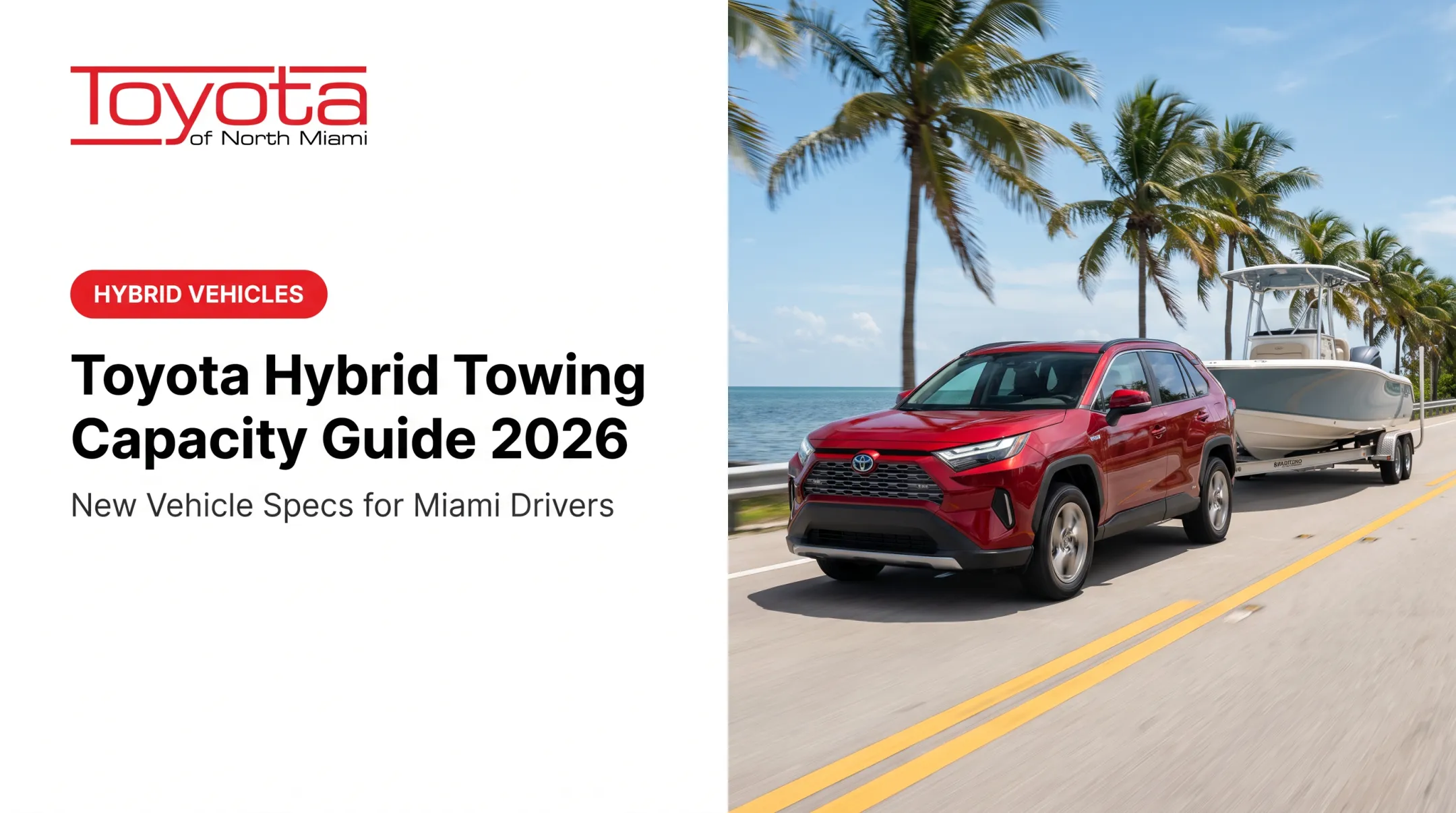
Here's the complication: the published maximum tow rating is just one piece of the puzzle. Loaded trailer weight, tongue weight, passengers, cargo, and the gear already in your RAV4 all count against the vehicle's limits. A trailer that weighs less than the advertised maximum can still overload your RAV4 if you're not accounting for everything else riding along.
This guide breaks down towing capacity trim-by-trim across the gas-free 2026 RAV4 lineup — Hybrid and Plug-in Hybrid — and walks through exactly how to confirm your specific configuration before you hook up a trailer.
Key Takeaways
- The 2026 RAV4 lineup tops out at 3,500 lbs of towing capacity, available on specific Hybrid AWD trims and three Plug-in Hybrid trims
- FWD Hybrid trims and LE AWD are capped at 1,750 lbs; AWD alone doesn't guarantee the higher rating
- Trailer weight limits refer to the fully loaded trailer, including cargo, water, and gear, not the empty or advertised dry weight
- A hitch receiver or wiring harness provides connection hardware only; it does not raise the RAV4's factory-certified towing, payload, or axle ratings
What Towing Capacity Represents in the 2026 RAV4
Towing capacity, or Trailer Weight Rating (TWR), is the maximum gross trailer weight Toyota certifies for a properly equipped RAV4 under specific test conditions. It is not a promise that every RAV4 configuration can handle that weight in every situation. Mountain grades, extreme heat, and heavy cabin loads all eat into your usable margin.
Toyota calculates this figure using the SAE J2807 testing standard, an industry-wide protocol that establishes minimum performance requirements at gross combination weight. The 2026 RAV4 Hybrid owner's manual confirms the vehicle meets this standard.
How Towing Connects to Other Weight Ratings
Towing capacity doesn't exist in isolation. It's tied to several other figures you'll find on your RAV4's certification label and owner's manual:
- GVWR (Gross Vehicle Weight Rating): The maximum total weight your loaded RAV4 can weigh, including passengers, cargo, and tongue weight
- GCWR (Gross Combined Weight Rating): The maximum combined weight of your loaded RAV4 plus the loaded trailer
- Front/Rear GAWR (Gross Axle Weight Rating): Separate weight limits for each axle; both must stay within range independently
- Payload/Load Carrying Capacity: Calculated as GVWR minus actual curb weight, this is your budget for occupants, cargo, and tongue weight combined
Dry weight versus loaded weight matters here. A trailer's advertised "dry weight" excludes water tanks, propane, batteries, camping gear, tools, and anything else you pack in. Your RAV4's rating applies to the trailer's loaded weight. Always use that number, not the brochure figure.

Factors That Influence the Published Rating
Several engineering and real-world factors determine whether your RAV4 lands at the lower or higher tow rating, and whether you can safely use the full number in practice.
Engineering factors Toyota builds into the rating:
- Hybrid-system output and transaxle design (the 2026 RAV4 Hybrid uses a 2.5-liter Dynamic Force four-cylinder with an electronically controlled CVT)
- Dedicated cooling: engine-oil, transmission-fluid, and hybrid-system coolers
- Drivetrain configuration: FWD versus AWD with All-Wheel Drive Integrated Management
- Brake system design, including Electronically Controlled Braking with regenerative braking integration
- Suspension tuning and tire specifications
Real-world conditions that reduce your effective margin, even when you're technically under the rated max:
- Steep grades and high ambient temperatures, which strain the cooling system and reduce available power
- Headwinds and a trailer's frontal area, which increase drag significantly
- Stop-and-go traffic, which demands more from brakes on a loaded combination
- Payload already carried inside the vehicle before you add tongue weight
One more thing worth being direct about: don't carry over ratings from older model years or other markets. A 2025 RAV4 figure, a Canadian-market spec, or a number from a RAV4 Prime doesn't automatically apply to the 2026 U.S. lineup.
Toyota's own press materials show trim names and equipment shifting between releases. The October 2025 arrival announcement renamed the "XLE" grade to "XLE Premium," for instance. Always confirm against current U.S. documentation.
2026 RAV4 Towing Capacity by Trim Level
Before you lock in a trim based on towing needs, know this upfront: there's no gas-only 2026 RAV4 in the U.S. The lineup is Hybrid and Plug-in Hybrid exclusively.
Gas-Powered RAV4 Trims
There isn't one. Toyota has moved the entire 2026 U.S. RAV4 lineup to electrified powertrains: Hybrid (HEV) and Plug-in Hybrid (PHEV). If you're cross-shopping based on older RAV4 generations that offered a standard gas engine, that configuration no longer exists for 2026.
Hybrid RAV4 Trims
The 2026 RAV4 Hybrid lineup spans six trims: LE, XLE Premium, SE, Woodland, XSE, and Limited. Towing capacity splits clearly along drivetrain and trim lines:
| Trim | Drivetrain | Max Towing Capacity |
|---|---|---|
| LE | FWD | 1,750 lbs |
| LE | AWD | 1,750 lbs |
| XLE Premium | FWD | 1,750 lbs |
| XLE Premium | AWD | 3,500 lbs |
| SE | FWD | 1,750 lbs |
| SE | AWD | 3,500 lbs |
| Woodland | AWD | 3,500 lbs |
| XSE | AWD | 3,500 lbs |
| Limited | AWD | 3,500 lbs |

Here's the detail that trips up a lot of shoppers: AWD alone doesn't unlock the 3,500-lb rating. LE AWD still caps at 1,750 lbs, the same as every FWD Hybrid trim. You need both AWD and the right trim tier to reach the higher number.
The Woodland trim stands out for towing-ready buyers: it comes with a factory-installed 2-inch rear tow-hitch receiver and wiring harness standard, so you're not sourcing that hardware separately.
Plug-In Hybrid RAV4 Trims
The 2026 RAV4 Plug-in Hybrid lineup includes SE, Woodland, XSE, and GR SPORT, all AWD. Toyota's official 2026 PHEV brochure confirms a 3,500-lb towing capacity for SE, XSE, and Woodland trims.
GR SPORT is a different story. Toyota's PHEV brochure doesn't list a numeric towing rating for GR SPORT in its 3,500-lb statement. If you're considering this trim specifically for towing, confirm the exact rating with a dealer or the owner's manual before assuming it matches the other three.
Don't confuse 2026 figures with older plug-in hybrid data, either. The 2025 RAV4 Plug-in Hybrid materials didn't explicitly publish a comparable towing figure, so there's no clean year-over-year comparison to lean on. Treat the 2026 number as its own standalone spec.
The PHEV's 2.5-liter Dynamic Force four-cylinder engine produces 324 combined net horsepower. The Woodland PHEV includes a standard tow hitch along with a CVT fluid warmer as part of its tow-preparation equipment.
Trim-Level Buying Guidance
The highest-rated trim isn't automatically the right call. Match the trim to your actual loaded trailer weight, not the other way around:
- If your trailer, fully loaded, stays under 1,750 lbs: A FWD Hybrid LE, XLE Premium, or SE covers you without paying for AWD you don't need for towing purposes
- If you need the 3,500-lb ceiling: You're looking at AWD XLE Premium, SE, Woodland, XSE, or Limited Hybrid trims, or SE, Woodland, or XSE PHEV trims
- If towing hardware matters out of the box: Woodland trims (Hybrid and PHEV) come tow-ready with a hitch receiver standard
Ready to see what's actually on the lot? You can check current 2026 RAV4 inventory at Toyota of North Miami and confirm the exact trim, drivetrain, and factory tow equipment on a specific VIN before you commit.
How to Match a Trailer to the RAV4's Rating
Matching a trailer to your RAV4 takes more than checking one number against another. Here's the process:
- Determine the trailer's fully loaded weight. Include cargo, water, fuel, propane, and gear, not the advertised dry weight.
- Set tongue weight correctly. The 2026 RAV4 Hybrid owner's manual specifies tongue weight at 9%–11% of gross trailer weight. Use this figure, not a generic 10–15% range pulled from another vehicle.
- Add vehicle occupants and cargo. These plus tongue weight must fit within your RAV4's payload capacity, found on the driver's doorjamb label.
- Check GCWR. The 2026 Hybrid manual lists GCWR ranging from 6,455 lbs (certain FWD configurations) up to 8,420 lbs for 3,500-lb-rated setups. Your loaded vehicle plus loaded trailer must stay under this combined figure.
- Confirm hitch and trailer-brake requirements separately. Toyota requires trailer brakes above 1,000 lbs of unbraked trailer weight, and a sway-control device is recommended above 2,000 lbs.

A trailer under the max rating can still be a problem. If tongue weight, cargo, and passengers push your rear axle or GCWR past its limit, the trailer's weight alone being "under the max" doesn't save you.
What Typically Fits Within RAV4 Ratings
With the caveat that you must confirm loaded specs for your specific trailer:
- Small utility trailers (landscaping, ATV hauling)
- Lightweight personal watercraft or small fishing boats
- Compact pop-up or teardrop campers
Trailer height, width, and frontal area also affect stability and fuel efficiency, even when weight is technically within limits. A tall, boxy trailer creates more drag and sway risk than a low, aerodynamic one at the same weight.
Pre-tow checklist:
- Hitch connection torqued and secure
- Safety chains crossed and attached
- Wiring harness connected: test brake lights, turn signals, taillights
- Tire pressures checked on both vehicle and trailer
- Load distributed evenly, tongue weight within range
- Mirrors adjusted for trailer visibility
- Trailer brakes functional if required by weight
How to Verify the Rating and Towing Equipment
Don't rely on trim name or memory: verify your exact vehicle's numbers.
- Driver-side door-jamb label: Lists GVWR and front/rear GAWR specific to your build
- VIN-specific build records: Confirm drivetrain and factory-installed equipment
- Owner's manual: Contains your powertrain's exact TWR, GCWR, and tongue-weight guidance
Know the difference between tow equipment types. A factory tow-prep package, a dealer-installed hitch receiver, a wiring harness, and an aftermarket hitch are not the same thing. A hitch receiver gives you a place to attach a trailer. It does not change your RAV4's certified GVWR, payload, or axle ratings. Only Toyota's factory specifications determine those limits.
When your load is close to a limit, weigh it. CAT Scale's locator finds certified public scales near you (no appointment needed). Pull onto the scale, use the intercom, and get a ticket showing axle-by-axle weights you can compare against your door-jamb ratings.

Not sure what your RAV4 is actually equipped with, or want genuine Toyota hitch hardware installed correctly? Toyota of North Miami's factory-trained service team can confirm compatible genuine Toyota parts, wiring, and equipment for your specific RAV4 build.
Operating Outside the Recommended Range and Common Misinterpretations
Exceeding your RAV4's towing or weight limits isn't just a paperwork problem.
Real consequences of overloading:
- Reduced braking performance and longer stopping distances
- Trailer sway, particularly with insufficient tongue weight
- Excessive strain on the transaxle, brakes, and cooling system
- Tire overload, leading to blowouts or premature wear
- Potential warranty complications: Toyota's warranty excludes damage directly caused by misuse, including overloading
Common mistakes worth avoiding:
- Treating the maximum rating as a comfortable everyday target rather than a ceiling
- Using a trailer's dry weight instead of its loaded weight
- Forgetting that roof cargo and extra passengers eat into payload before you even hitch up
- Assuming AWD automatically means the higher tow rating (it doesn't; see LE AWD)
- Applying a 2025 RAV4 or Canadian-market figure to a 2026 U.S. model
Accessories like helper springs, upgraded tires, or a brake controller can improve control and ride quality, but they can't independently raise Toyota's certified ratings. A RAV4 can look perfectly level and drive smoothly while still exceeding a payload or axle limit; appearance isn't a substitute for checking the actual numbers.
Conclusion
The right towing answer for a 2026 RAV4 depends entirely on your exact trim, drivetrain, and powertrain: there's no single number that applies across the lineup. FWD Hybrid trims and LE AWD cap at 1,750 lbs, while higher Hybrid AWD trims and most PHEV trims reach 3,500 lbs.
Match your trailer's loaded weight, not its empty weight, against every applicable rating — towing capacity, payload, GVWR, and GCWR all apply simultaneously. Before you tow or buy, confirm your specific vehicle's door-jamb label, owner's manual, and factory equipment against current Toyota documentation.
Frequently Asked Questions
Which Toyota RAV4 models can tow 3,500 lbs?
For 2026, AWD versions of the Hybrid XLE Premium, SE, Woodland, XSE, and Limited reach 3,500 lbs, along with PHEV SE, Woodland, and XSE. Always confirm your specific trim and drivetrain combination before assuming this rating applies.
How can I tell if my RAV4 has a towing package?
Check the driver-side door-jamb label and your vehicle's build records for installed equipment, then look for a hitch receiver and wiring harness. A Toyota dealer can confirm factory-installed towing equipment using your VIN.
How much can a 2026 RAV4 Plug-in Hybrid tow?
SE, Woodland, and XSE PHEV trims are rated for 3,500 lbs according to Toyota's 2026 brochure. GR SPORT's rating isn't specified in that same document, so confirm separately before towing.
Can the Toyota RAV4 tow 5,000 pounds?
No 2026 RAV4 configuration is officially rated for 5,000 lbs — the maximum across the lineup is 3,500 lbs. If your loaded trailer exceeds that, you'll need a larger vehicle like the Highlander or Sequoia.
Is the Toyota RAV4 Hybrid good for towing?
The RAV4 Hybrid works well for lightweight trailers like small utility trailers or compact campers, provided you stay within its 1,750 or 3,500-lb rating depending on trim. Always account for payload and tongue weight alongside the headline towing figure.
Is the Toyota RAV4 good for towing?
The RAV4 suits properly matched lightweight loads rather than heavy trailers or campers. Choose your trim based on your actual loaded trailer weight, and confirm GVWR, payload, and GCWR limits before hitching up.